
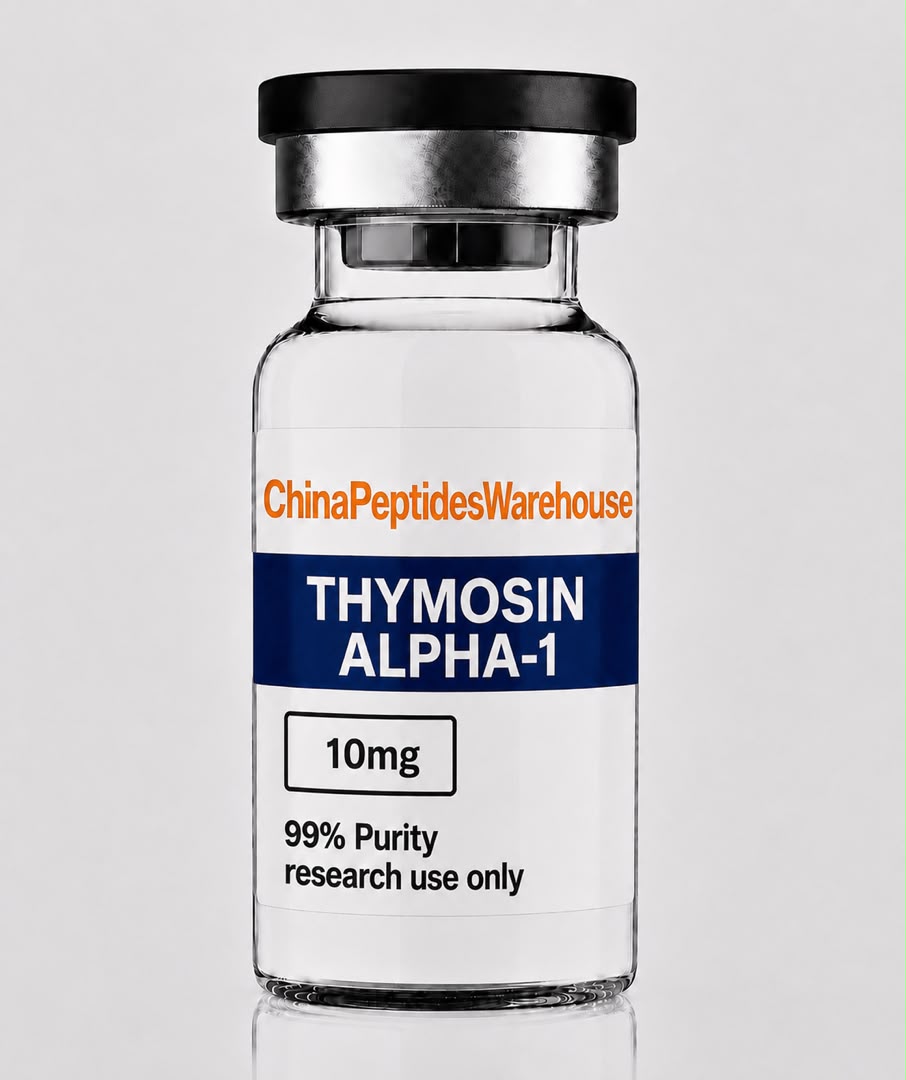
BUY THYMOSIN ALPHA-1 10mg
$198.00
THYMOSIN ALPHA-1 is a regulatory immunomodulator rather than a simple immune stimulant. It balances immune responses by upregulating protective Th1 cytokines (IL-2, IFN-$\gamma$) while modulating regulatory T-cell (Treg) function to prevent uncontrolled hyper-inflammatory signaling.
THYMOSIN ALPHA-1 (Ta1) Immune System & T-Cell Modulation Guide
Advanced Immunomodulatory Peptide, Thymic Function Restoration, Pathogen Defense, and Adaptive Immunity Regulation
Product Overview & Core Attributes
THYMOSIN ALPHA-1 (chemically known as Thymalfasin or Ta1; sequence: $\text{Ac-Ser-Asp-Ala-Ala-Val-Asp-Thr-Ser-Ser-Glu-Ile-Thr-Thr-Lys-Asp-Leu-Lys-Glu-Lys-Lys-Glu-Val-Val-Glu-Glu-Ala-Glu-Asn-OH}$) is an endogenous 28-amino acid peptide originally isolated from thymic tissue (Thymosin Fraction 5). As a master regulator of the adaptive and innate immune systems, THYMOSIN ALPHA-1 restores, enhances, and balances immune responsiveness without triggering excessive, harmful systemic inflammation.
At the cellular level, THYMOSIN ALPHA-1 acts primarily on immature T-lymphocytes within the thymus and peripheral immune tissues. It binds to specific Toll-like receptors (specifically TLR-3, TLR-7, and TLR-9) on dendritic cells and myeloid cells. This binding initiates intracellular signaling cascades—including the MyD88-dependent pathway—which lead to the maturation and differentiation of naive T-cells into functional cytotoxic $\text{CD8}^+$ T-lymphocytes, helper $\text{CD4}^+$ T-cells, and natural killer (NK) cells.
Beyond cell differentiation, THYMOSIN ALPHA-1 upregulates the expression of Major Histocompatibility Complex Class I (MHC-I) molecules and key cytokines such as Interleukin-2 (IL-2) and Interferon-gamma (IFN-$\gamma$). Through this dual mechanism, THYMOSIN ALPHA-1 helps the body recognize and eliminate viral pathogens, intracellular bacteria, and aberrant malignant cells, making it an essential subject in chronic infection, oncology, autoimmune, and longevity research.
                               +------------------------------------------+
                               |             THYMOSIN ALPHA-1             |
                               |      28-Amino Acid Thymic Peptide        |
                               +--------------------+---------------------+
                                                    |
           +----------------------------------------+----------------------------------------+
           |                                                                                 |
           v                                                                                 v
+------------------------------------+                                            +------------------------------------+
|   TLR-3, TLR-7 & TLR-9 Agonism     |                                            |    MHC-I & Cytokine Expression     |
|   (Dendritic & Myeloid Cells)      |                                            |           Upregulation             |
+------------------+-----------------+                                            +------------------+-----------------+
                   |                                                                                 |
                   v                                                                                 v
  Promotes Maturation of Naive T-Cells                                            Increases Production of IL-2, IFN-γ,  |
  into CD4+, CD8+ & NK Cells                                                      and Enhances Antigen Presentation    |
                   |                                                                                 |
                   v                                                                                 v
  Restores Innate & Adaptive Immunity                                             Directs Target Cell Lysis &          |
  Balance (Treg Function Modulation)                                             Pathogen Clearance                   |
                   |                                                                                 |
                   +------------------------------------+--------------------------------------------+
                                                        |
                                                        v
                                       +----------------------------------+
                                       | Immune System Homeostasis, Viral |
                                       | Clearance & Cellular Resilience  |
                                       +----------------------------------+
Key Technical Features:
-
Selective TLR Agonism: Agonizes TLR-3, TLR-7, and TLR-9 pathways on dendritic cells, initiating coordinated innate and adaptive immune responses.
-
T-Cell Differentiation & Maturation: Drives the maturation of naive precursor T-cells into functional $\text{CD4}^+$, $\text{CD8}^+$ T-helper/cytotoxic cells, and NK cells.
-
MHC-I Expression Enhancement: Increases expression of Major Histocompatibility Complex Class I molecules to improve antigen presentation and target cell recognition.
-
Balanced Cytokine Modulation: Stimulates protective Th1 cytokines (IL-2, IFN-$\gamma$) while regulating regulatory T-cell (Treg) function to prevent hyper-inflammatory damage.
-
Thymic Involution Mitigation: Counteracts age-related thymic decay, preserving immune vigilance and cellular defense mechanisms.
Technical & Chemical Specifications
Review the chemical, analytical, and physical properties defining research-grade THYMOSIN ALPHA-1:
| Feature / Parameter | Analytical Specification |
| Chemical Name | Thymalfasin, $\text{N}^\alpha$-acetylthymosin $\alpha_1$ |
| CAS Registry Number | 62304-98-7 |
| Synonyms | Ta1, Zadaxin, Thymosin $\alpha_1$ |
| Molecular Formula | $\text{C}_{129}\text{H}_{215}\text{N}_{33}\text{O}_{55}$ |
| Molecular Weight | 3108.30 g/mol |
| Sequence Profile | Ac-Ser-Asp-Ala-Ala-Val-Asp-Thr-Ser-Ser-Glu-Ile-Thr-Thr-Lys-Asp-Leu-Lys-Glu-Lys-Lys-Glu-Val-Val-Glu-Glu-Ala-Glu-Asn-OH |
| Purity Standard | $\ge 98.0\%$ (determined via RP-HPLC and ESI-MS) |
| Physical Appearance | Sterile, lyophilized white cake/powder |
| Solubility Profile | Fully soluble in sterile water, PBS ($\text{pH } 7.4$), and physiological saline |
| Mechanism of Action | TLR-3/7/9 agonist, T-cell differentiator, immunomodulator |
| Storage Temperature | Freeze-stored at $-20^\circ\text{C}$ to $-80^\circ\text{C}$ in desiccated conditions |
Reconstitution & Handling Protocol
To maintain chemical integrity and prevent structural breakdown, standard aseptic guidelines must be observed during reconstitution and handling.
+-------------------------------------------------------------------------+
|                  LABORATORY RECONSTITUTION STEPS                        |
+-------------------------------------------------------------------------+
| Step 1: Equilibrium   --> Allow vial to reach room temp (15-20 min)     |
| Step 2: Sterilization --> Clean rubber septum with 70% IPA swab         |
| Step 3: Diluent Intro --> Slow injection of Bacteriostatic Water        |
| Step 4: Solubilization--> Gentle circular swirling (DO NOT SHAKE)       |
| Step 5: Cold Storage  --> Store liquid at 2°C to 8°C (Refrigerated)     |
+-------------------------------------------------------------------------+
Equipment & Reagents:
-
Lyophilized Vial: Standard 5 mg or 10 mg sterile glass vial.
-
Reagent Diluent: Bacteriostatic Water (0.9% Benzyl Alcohol preserved), Sterile Water for Injection, or Phosphate-Buffered Saline (PBS).
-
Equipment: Sterile 1 mL to 3 mL injection syringes with 21G–27G needles.
-
Disinfectant: Medical-grade 70% Isopropyl Alcohol (IPA) wipes.
Step-by-Step Reconstitution Protocol:
-
Temperature Balancing: Allow the frozen vial to reach room temperature for 15 to 20 minutes before handling to prevent moisture condensation inside the vial.
-
Septum Disinfection: Remove the flip-off cap. Thoroughly wipe the rubber stopper using a fresh 70% IPA swab and allow it to air-dry completely.
-
Diluent Injection: Draw up the measured diluent volume (e.g., 2.0 mL for a 10 mg vial to achieve a 5 mg/mL concentration). Insert the needle through the center of the septum at a 45-degree angle.
-
Controlled Wall Flow: Slowly depress the syringe plunger, aiming the fluid stream against the inner glass wall of the vial. Avoid spraying liquid directly onto the lyophilized powder cake.
-
Solubilization: Allow the diluent to fully saturate the powder. Gently swirl the vial in a smooth circular motion. Do not shake the vial violently, as mechanical agitation can disrupt delicate peptide bonds.
-
Visual Inspection: Verify that the reconstituted liquid is completely clear, colorless, and free of undissolved particulate matter before use.
Storage Requirements & Temperature Stability
Adhering to proper storage conditions protects THYMOSIN ALPHA-1 from thermal degradation and hydrolysis over time:
+--------------------------------------------------------------------+
|                  TEMPERATURE STABILITY MATRIX                      |
+--------------------------------------------------------------------+
|  Dry Powder (-20°C to -80°C)  | Stable for up to 36 Months         |
|  Dry Powder (Room Temp / 20°C)| Stable for 3-4 Weeks (Transit)     |
|  Reconstituted Liquid (2°-8°C)| Stable for up to 6-8 Weeks         |
|  Reconstituted Liquid (>25°C) | Degrades Rapidly (Avoid Exposure)  |
+--------------------------------------------------------------------+
-
Lyophilized Powder: Store unhydrated, sealed vials in a freezer at $-20^\circ\text{C}$ to $-80^\circ\text{C}$. Under these conditions, the powder remains stable for up to 36 months.
-
Reconstituted Solution: Once dissolved in bacteriostatic water, store liquid vials under refrigeration at $2^\circ\text{C}$ to $8^\circ\text{C}$. Use within 60 days to maintain maximum potency.
-
Freezing Reconstituted Aliquots: For long-term storage of liquid stock, divide into single-use aliquots and store at $-80^\circ\text{C}$. Avoid repeated freeze-thaw cycles.
-
Light Protection: Store vials inside secondary opaque packaging away from direct light and UV sources.
Sourcing Standards & Procurement Guidance
When evaluating options to buy THYMOSIN ALPHA-1 or selecting high-purity research materials online, verifying independent laboratory testing ensures batch quality and experimental repeatability.
+--------------------------------------------------------------------+
|                 PEPTIDE SOURCING QUALITY CHECKLIST                 |
+--------------------------------------------------------------------+
|  [x] High-Performance Liquid Chromatography (HPLC) Purity >= 98%   |
|  [x] Mass Spectrometry (MS) Identity Verification (3108.30 g/mol)  |
|  [x] Endotoxin & Sterile Screening (< 0.05 EU/mg)                  |
|  [x] Vacuum-Sealed Borosilicate Glass Vials with Intact Seals      |
|  [!] AVOID: Sellers lacking lot-specific analytical COA reports    |
+--------------------------------------------------------------------+
1. Analytical Certificate of Analysis (COA) Verification
Always request a lot-specific COA from an accredited testing laboratory. A complete analytical certificate must document:
-
RP-HPLC Analysis: Confirms that the target peak area represents $\ge 98.0\%$ purity, ensuring freedom from synthesis side-products or truncated peptide sequences.
-
Mass Spectrometry (ESI-MS): Confirms that the molecular weight matches the theoretical 3108.30 g/mol value.
-
Endotoxin & Sterility Testing: Validates that endotoxin levels remain below $<0.05\text{ EU/mg}$ and confirms product sterility.
THYMOSIN ALPHA-1
2. Evaluating Vendor Quality
Researchers searching for reliable outlets to THYMOSIN ALPHA-1 buy orders online should prioritize verified suppliers offering cold-chain delivery, batch traceability, and clear third-party documentation. High-purity THYMOSIN ALPHA-1 for sale online is distributed in vacuum-sealed borosilicate glass vials to maintain structural stability during transit. If you are reviewing vendors to buy THYMOSIN ALPHA-1 stock for laboratory assays, ensure third-party HPLC reports are accessible for every batch.
Customer & Researcher Reviews
Read documented feedback from research professionals and laboratory specialists evaluating product purity and performance:
“Exceptional T-Cell Differentiation Markers in Infection Models”
“Our immunology laboratory evaluated this thymic peptide in viral clearance and T-cell response assays. The material reconstituted completely in sterile PBS within seconds. HPLC analysis provided by the vendor matched our internal testing at 98.6% purity. We observed a significant increase in active CD8+ cytotoxic T-cell populations.”
— Dr. Aris H., Senior Immunology Specialist
“Consistent High-Purity Material for Immune Regulation Studies”
“We utilize this peptide to study dendritic cell activation via TLR-7 and TLR-9 pathways. Order delivery was prompt, arriving in vacuum-sealed packaging with full COA documentation. The consistency across multiple orders makes our experimental data highly reproducible.”
— Elena M., Cellular Pathology Research Lead
“Rapid Solubilization and Excellent Batch Quality”
“Having a trustworthy source for high-purity immunomodulatory peptides is vital for our lab operations. The lyophilized cake dissolved clearly without precipitation. Having lot-specific mass spectrometry verification gives our research team complete peace of mind.”
— Marcus L., Laboratory Operations Director
Frequently Asked Questions (FAQ)
Q1: How does THYMOSIN ALPHA-1 differ from Thymosin Beta-4 (TB-500)?
While both originate from thymic tissue, their primary mechanisms differ completely. THYMOSIN ALPHA-1 is an 28-amino acid immunomodulator that activates TLR pathways, drives T-cell maturation, and regulates cytokine response. Thymosin Beta-4 (TB-500) is an actin-sequestering peptide focused on tissue repair, angiogenesis, cell migration, and wound healing.
Q2: What is the primary role of TLR agonist activity in THYMOSIN ALPHA-1?
THYMOSIN ALPHA-1 acts as an agonist at Toll-like receptors (TLR-3, TLR-7, and TLR-9) on dendritic and myeloid cells. This interaction triggers intracellular MyD88 signaling pathways that stimulate mature antigen presentation, promote T-cell differentiation, and elevate protective Th1 cytokines.
Q3: What diluent is recommended for reconstituting THYMOSIN ALPHA-1?
For multi-dose laboratory applications requiring refrigerated storage, sterile Bacteriostatic Water (0.9% Benzyl Alcohol preserved) is standard. For immediate single-use assays or cell culture, sterile Water for Injection or Phosphate-Buffered Saline (PBS, $\text{pH } 7.4$) may be used.
Q4: How long does the reconstituted liquid solution remain stable?
When dissolved in bacteriostatic water and stored under refrigeration ($2^\circ\text{C}$ to $8^\circ\text{C}$), the liquid solution retains full chemical stability for up to 60 days.
Q5: Does THYMOSIN ALPHA-1 cause excessive systemic inflammation or cytokine storms?
No. THYMOSIN ALPHA-1 is a regulatory immunomodulator rather than a simple immune stimulant. It balances immune responses by upregulating protective Th1 cytokines (IL-2, IFN-$\gamma$) while modulating regulatory T-cell (Treg) function to prevent uncontrolled hyper-inflammatory signaling.
Q6: What physical signs indicate peptide degradation?
Physical indicators of degradation include persistent turbidity, cloudiness, or insoluble floating particles after mixing. If the reconstituted solution fails to clear completely after gentle circular swirling, discard the vial.
Q7: What analytical methods are used to verify THYMOSIN ALPHA-1 purity?
Chemical purity is measured using Reverse-Phase High-Performance Liquid Chromatography (RP-HPLC), while exact molecular weight and chemical identity are verified via Electrospray Ionization Mass Spectrometry (ESI-MS).
Summary & Key Takeaways
THYMOSIN ALPHA-1 (Thymalfasin) remains a fundamental compound in immunology and infectious disease research. By agonizing TLR-3/7/9 pathways, driving T-cell maturation, and restoring balanced cytokine expression, this 28-amino acid thymic peptide provides a robust mechanism for modulating adaptive and innate immune responses.
When selecting1 THYMOSIN ALPHA-for laboratory research, choose verified suppliers offering lot-specific COA reports, high HPLC purity ratings ($\ge 98.0\%$), and proper cold-chain handling to ensure consistent experimental outcomes.
Reviews
There are no reviews yet.