
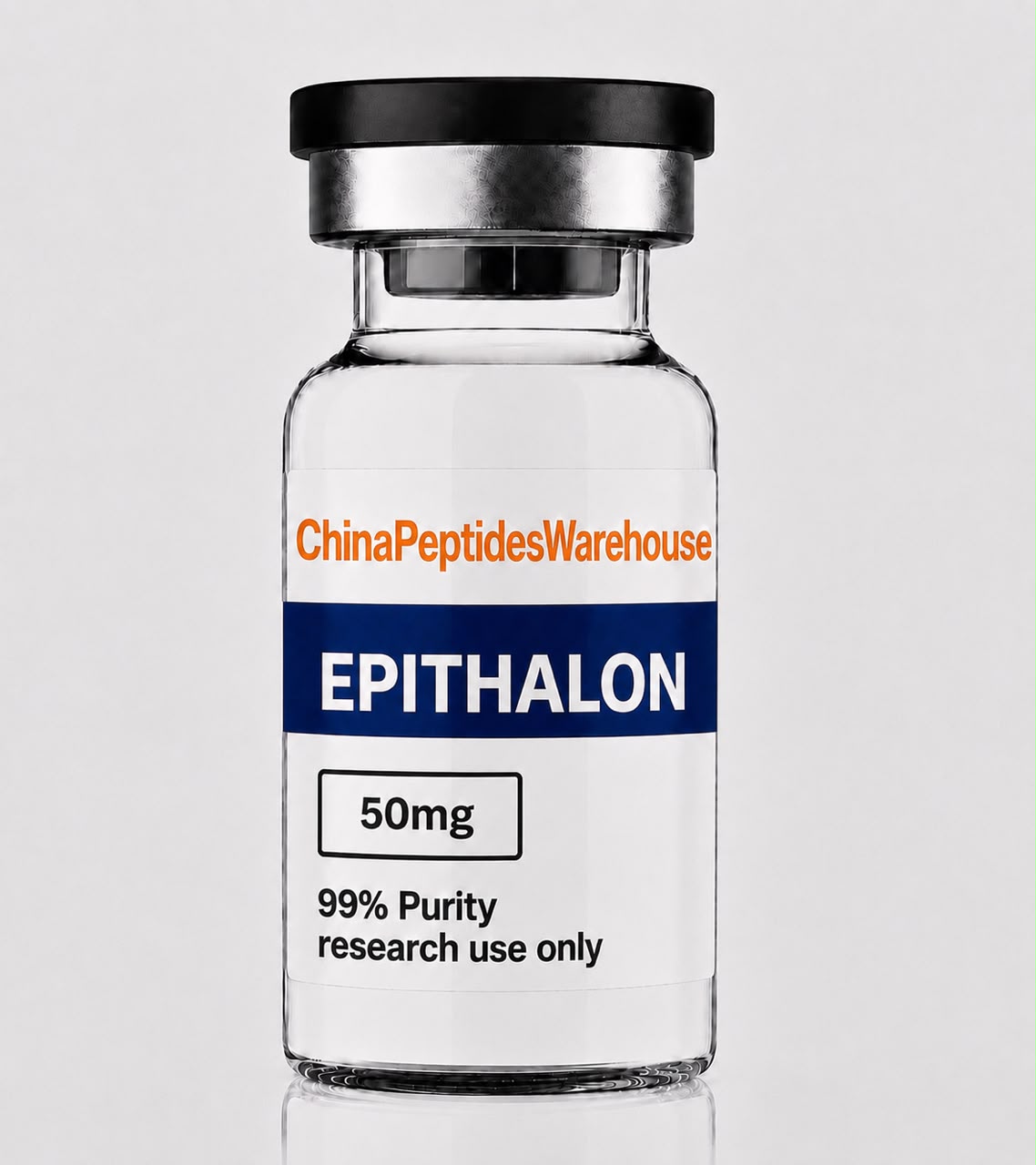
BUY EPITHALON 50mg
$165.00
EPITHALON (chemically known as Epitalon or Epithalone; peptide sequence: $\text{Ala-Glu-Asp-Gly}$) is a synthetic tetrapeptide modeled after Epithalamin, a natural polypeptide extract isolated from the pineal gland. Discovered by Professor Vladimir Khavinson at the St. Petersburg Institute of Bioregulation and Gerontology, EPITHALON represents a major breakthrough in peptide gerontology, cellular senescence reversal, and neuroendocrine regulation.
(Epitalon) Synthetic Telomerase Activator Guide
Advanced Epithalamin-Derived Tetrapeptide, Telomere Length Maintenance, Anti-Aging Regulation, and Circadian Rhythm Restoration
Product Overview & Core Attributes
EPITHALON (chemically known as Epitalon or Epithalone; peptide sequence: $\text{Ala-Glu-Asp-Gly}$) is a synthetic tetrapeptide modeled after Epithalamin, a natural polypeptide extract isolated from the pineal gland. Discovered by Professor Vladimir Khavinson at the St. Petersburg Institute of Bioregulation and Gerontology, EPITHALON represents a major breakthrough in peptide gerontology, cellular senescence reversal, and neuroendocrine regulation.
At the cellular level, EPITHALON acts as a direct epigenetic regulator and telomerase activator. Telomeres—repetitive nucleoprotein caps ($\text{TTAGGG}$) situated at the ends of linear eukaryotic chromosomes—shorten with each cycle of DNA replication during cellular division. Upon reaching a critical threshold known as the Hayflick Limit, the cell enters irreversible cell-cycle arrest (senescence) or undergoes apoptosis. EPITHALON upregulates human telomerase reverse transcriptase (hTERT) gene expression, facilitating the elongation and maintenance of shortened telomeres in somatic cells.
Beyond telomere elongation, EPITHALON restores pineal gland sensitivity, normalizes night-time melatonin secretion, and resets central circadian signaling in the suprachiasmatic nucleus (SCN). This dual mechanism—combining direct telomeric repair with neuroendocrine alignment—reduces oxidative stress, suppresses spontaneous tumor development in long-term models, and slows cellular aging.
                               +------------------------------------------+
                               |                EPITHALON                 |
                               |    Synthetic Tetrapeptide (Ala-Glu-Asp-Gly) |
                               +--------------------+---------------------+
                                                    |
           +----------------------------------------+----------------------------------------+
           |                                                                                 |
           v                                                                                 v
+------------------------------------+                                            +------------------------------------+
|    Epigenetic DNA & hTERT Gene     |                                            |     Pineal Gland Neuroendocrine    |
|            Activation              |                                            |            Restoration             |
+------------------+-----------------+                                            +------------------+-----------------+
                   |                                                                                 |
                   v                                                                                 v
   Upregulates Telomerase Activity,                                                Restores Endogenous Melatonin Pulse,
   Elongates Shortened Telomeres                                                  Resets Central Circadian Rhythm
                   |                                                                                 |
                   v                                                                                 v
  Delays Cellular Senescence & Extends                                             Normalizes Endocrine Pathways &
        Cell Division Limits                                                      Reduces Systemic Oxidative Stress
                   |                                                                                 |
                   +------------------------------------+--------------------------------------------+
                                                        |
                                                        v
                                       +----------------------------------+
                                       | Systemic Cellular Rejuvenation,  |
                                       | Organic Protection & Longevity   |
                                       +----------------------------------+
Key Technical Features:
-
hTERT Expression & Telomerase Activation: Direct epigenetic activation of the hTERT gene to restore telomerase activity and extend telomeric repeat sequences.
-
Pineal Gland & Melatonin Modulation: Resets pineal sensitivity, restoring youthful night-time melatonin output and circadian signaling.
-
Cellular Senescence Reversal: Enables somatic cells to overcome the Hayflick Limit, promoting tissue repair and cellular longevity.
-
Antioxidant & Oxidative Stress Suppression: Enhances primary endogenous antioxidant enzymes, including superoxide dismutase (SOD) and glutathione peroxidase (GPx).
-
Neuroendocrine System Normalization: Balances pituitary-adrenal signaling, helping stabilize hormonal function during age-related decline.
Technical & Chemical Specifications
Review the chemical, structural, and physiological parameters defining research-grade EPITHALON:
| Feature / Parameter | Analytical Specification |
| Chemical Name | L-alanyl-L-$\alpha$-glutamyl-L-$\alpha$-aspartyl-glycine |
| CAS Registry Number | 307297-39-8 |
| Synonyms | Epitalon, Epithalone, AEDG, Khavinson Peptide |
| Molecular Formula | $\text{C}_{14}\text{H}_{22}\text{N}_4\text{O}_9$ |
| Molecular Weight | 390.35 g/mol |
| Peptide Sequence | Ala-Glu-Asp-Gly |
| Purity Standard | $\ge 98.0\%$ (determined via RP-HPLC and ESI-MS) |
| Physical Appearance | Sterile, lyophilized white cake/powder |
| Solubility Profile | Water ($\ge 10\text{ mg/mL}$), PBS ($\text{pH } 7.4$), Physiological Saline |
| Mechanism of Action | Epigenetic hTERT upregulator, pineal gland & circadian modulator |
| Storage Temperature | Freeze-stored at $-20^\circ\text{C}$ to $-80^\circ\text{C}$ in desiccated conditions |
Reconstitution & Handling Protocol
To ensure structural stability and maintain solubility, standard laboratory guidelines must be observed during reconstitution and handling.
+-------------------------------------------------------------------------+
|                  LABORATORY RECONSTITUTION STEPS                        |
+-------------------------------------------------------------------------+
| Step 1: Equilibrium   --> Allow vial to reach room temp (15-20 min)     |
| Step 2: Sterilization --> Clean rubber septum with 70% IPA swab         |
| Step 3: Diluent Intro --> Slow injection of Bacteriostatic Water        |
| Step 4: Solubilization--> Gentle circular swirling (DO NOT SHAKE)       |
| Step 5: Cold Storage  --> Store liquid at 2°C to 8°C (Refrigerated)     |
+-------------------------------------------------------------------------+
Equipment & Reagents:
-
Lyophilized Vial: Standard 10 mg, 20 mg, or 50 mg sterile glass vial.
-
Reagent Diluent: Bacteriostatic Water (0.9% Benzyl Alcohol preserved), Sterile Water for Injection, or Phosphate-Buffered Saline (PBS).
-
Equipment: Sterile 1 mL to 3 mL syringes with 21G–27G needles.
-
Disinfectant: Medical-grade 70% Isopropyl Alcohol (IPA) wipes.
Step-by-Step Reconstitution Protocol:
-
Temperature Balancing: Allow the frozen vial to equilibrate to room temperature for 15 to 20 minutes before handling to prevent condensation inside the glass container.
-
Septum Disinfection: Pop off the flip-off protective cap. Thoroughly wipe the rubber stopper using a fresh 70% IPA swab and allow it to air-dry completely.
-
Diluent Injection: Draw up the measured diluent volume (e.g., 2.0 mL for a 10 mg vial to achieve a 5 mg/mL concentration). Insert the needle through the center of the septum at a 45-degree angle.
-
Controlled Wall Flow: Slowly depress the syringe plunger, directing the fluid stream against the inner glass wall. Avoid spraying liquid directly onto the lyophilized powder cake.
-
Solubilization: Allow the diluent to absorb into the powder. Gently swirl the vial in a smooth circular motion. Do not shake the vial violently, as mechanical agitation can introduce air bubbles and disrupt peptide bonds.
-
Visual Inspection: Verify that the reconstituted liquid is completely clear, colorless, and free of undissolved particulate matter before use.
Storage Requirements & Temperature Stability
Adhering to proper storage conditions protects EPITHALON from thermal degradation and hydrolysis over time:
+--------------------------------------------------------------------+
|                  TEMPERATURE STABILITY MATRIX                      |
+--------------------------------------------------------------------+
|  Dry Powder (-20°C to -80°C)  | Stable for up to 36 Months         |
|  Dry Powder (Room Temp / 20°C)| Stable for 3-4 Weeks (Transit)     |
|  Reconstituted Liquid (2°-8°C)| Stable for up to 6-8 Weeks         |
|  Reconstituted Liquid (>25°C) | Degrades Rapidly (Avoid Exposure)  |
+--------------------------------------------------------------------+
-
Lyophilized Powder: Store unhydrated, sealed vials in a freezer at $-20^\circ\text{C}$ to $-80^\circ\text{C}$. Under these conditions, the powder remains stable for up to 36 months.
-
Reconstituted Solution: Once dissolved in bacteriostatic water, store liquid vials under refrigeration at $2^\circ\text{C}$ to $8^\circ\text{C}$. Use within 60 days to maintain maximum potency.
-
Freezing Reconstituted Aliquots: For extended storage of liquid stock, divide into single-use aliquots and store at $-80^\circ\text{C}$. Avoid repeated freeze-thaw cycles.
-
Light Protection: Store vials inside secondary opaque packaging away from direct light and light sources.
Sourcing Standards & Procurement Guidance
When evaluating options to buy EPITHALON or selecting high-purity research materials online, verifying independent laboratory testing ensures consistent batch quality and experimental reliability.
+--------------------------------------------------------------------+
|                 PEPTIDE SOURCING QUALITY CHECKLIST                 |
+--------------------------------------------------------------------+
|  [x] High-Performance Liquid Chromatography (HPLC) Purity >= 98%   |
|  [x] Mass Spectrometry (MS) Identity Verification (390.35 g/mol)   |
|  [x] Low Endotoxin & Residual Solvent Analysis (< 0.05 EU/mg)      |
|  [x] Vacuum-Sealed Borosilicate Glass Vials with Intact Seals      |
|  [!] AVOID: Sellers lacking lot-specific analytical COA reports    |
+--------------------------------------------------------------------+
1. Analytical Certificate of Analysis (COA) Verification
Always request a lot-specific COA from an accredited testing facility. A complete analytical certificate must document:
-
RP-HPLC Analysis: Confirms that the target peak area represents $\ge 98.0\%$ purity, ensuring freedom from synthesis side-products or truncated sequences.
-
Mass Spectrometry (ESI-MS): Confirms that the molecular weight matches the theoretical 390.35 g/mol standard.
-
Endotoxin & Sterility Testing: Validates that endotoxin levels remain below $<0.05\text{ EU/mg}$ and confirms product sterility.
2. Evaluating Vendor Quality
Researchers searching to EPITHALON buy inventory online should prioritize suppliers offering cold-chain delivery, batch traceability, and clear third-party documentation. Standard high-purity EPITHALON for sale online is distributed in vacuum-sealed vials to protect structural stability during transit. If you are comparing sources to buy EPITHALON stock for laboratory assays, ensure third-party HPLC reports are accessible for every batch.
Customer & Researcher Reviews
Read documented feedback from research professionals and laboratory specialists evaluating product purity and performance:
“Measurable Reversal in Fibroblast Senescence Assays”
“Our longevity laboratory tested this tetrapeptide in human dermal fibroblast culture models to measure telomerase activity and cell division capacity. HPLC analysis supplied by the vendor matched our internal testing at 98.7% purity. Reconstitution in PBS was immediate, and we observed a clear increase in hTERT expression.”
— Dr. Aris P., Senior Gerontology Specialist
“Restored Circadian Rhythm Markers in Animal Models”
“We utilized this compound to study pineal gland regulation and nocturnal melatonin secretion in aged murine models. Order delivery was prompt, arriving in vacuum-sealed packaging with lot-specific COA documentation. The restoration of normal night-time endocrine pulses was consistent across all test sets.”
— Elena B., Neuroendocrine Research Lead
“High Batch Uniformity and Excellent Water Solubility”
“Having a reliable source for short bioregulatory peptides is critical for our research group. This lyophilized cake dissolved completely in bacteriostatic water within seconds, yielding a crystal-clear solution. Batch-to-batch consistency over three separate orders has been flawless.”
— Marcus G., Laboratory Operations Director
Frequently Asked Questions (FAQ)
Q1: How does EPITHALON differ from natural Epithalamin?
Epithalamin is a complex natural peptide extract derived from bovine pineal glands. EPITHALON is a synthetic tetrapeptide (Ala-Glu-Asp-Gly) representing the active core sequence of Epithalamin. Being synthetic, it offers higher purity, precise concentration control, and freedom from biological contaminants.
Q2: What is the primary mechanism of telomerase activation by EPITHALON?
EPITHALON interacts directly with promoter regions on DNA to induce epigenetic up-regulation of the hTERT (human telomerase reverse transcriptase) gene. This increases endogenous telomerase enzyme activity, which adds telomeric repeats ($\text{TTAGGG}$) to shortened chromosome ends.
Q3: What diluent is recommended for reconstituting EPITHALON?
For multi-dose laboratory applications requiring refrigerated storage, sterile Bacteriostatic Water (0.9% Benzyl Alcohol preserved) is standard. For immediate single-use assays or cell culture, sterile Water for Injection or Phosphate-Buffered Saline (PBS, $\text{pH } 7.4$) may be used.
Q4: How long does the reconstituted solution remain stable?
When dissolved in bacteriostatic water and stored under refrigeration ($2^\circ\text{C}$ to $8^\circ\text{C}$), the liquid solution retains full chemical stability for up to 60 days.
Q5: Can EPITHALON cross cell membranes and nuclear barriers?
Yes. Due to its short tetrapeptide sequence and low molecular weight (390.35 g/mol), EPITHALON readily diffuses across cell membranes and enters the nucleus, where it interacts directly with genomic DNA regions.
Q6: What physical signs indicate peptide degradation?
Physical signs of degradation include persistent turbidity, cloudiness, or undissolved particles after reconstitution. If the liquid fails to clear completely after gentle circular swirling, discard the vial.
Q7: What analytical methods are used to verify EPITHALON quality?
Chemical purity is evaluated using Reverse-Phase High-Performance Liquid Chromatography (RP-HPLC), while exact molecular mass and sequence accuracy are verified via Electrospray Ionization Mass Spectrometry (ESI-MS).
Summary & Key Takeaways
EPITHALON (Epitalon) remains a cornerstone in peptide gerontology and pineal gland bioregulation research. By inducing hTERT gene expression, extending shortened telomeres, and restoring natural melatonin secretion, this synthetic tetrapeptide provides a dual-action mechanism for reversing cellular senescence and protecting against oxidative stress.
When selecting EPITHALON for laboratory research, choose verified suppliers providing lot-specific COA documentation, high HPLC purity ratings ($\ge 98.0\%$), and proper cold-chain shipping to ensure reliable experimental outcomes.
Reviews
There are no reviews yet.