
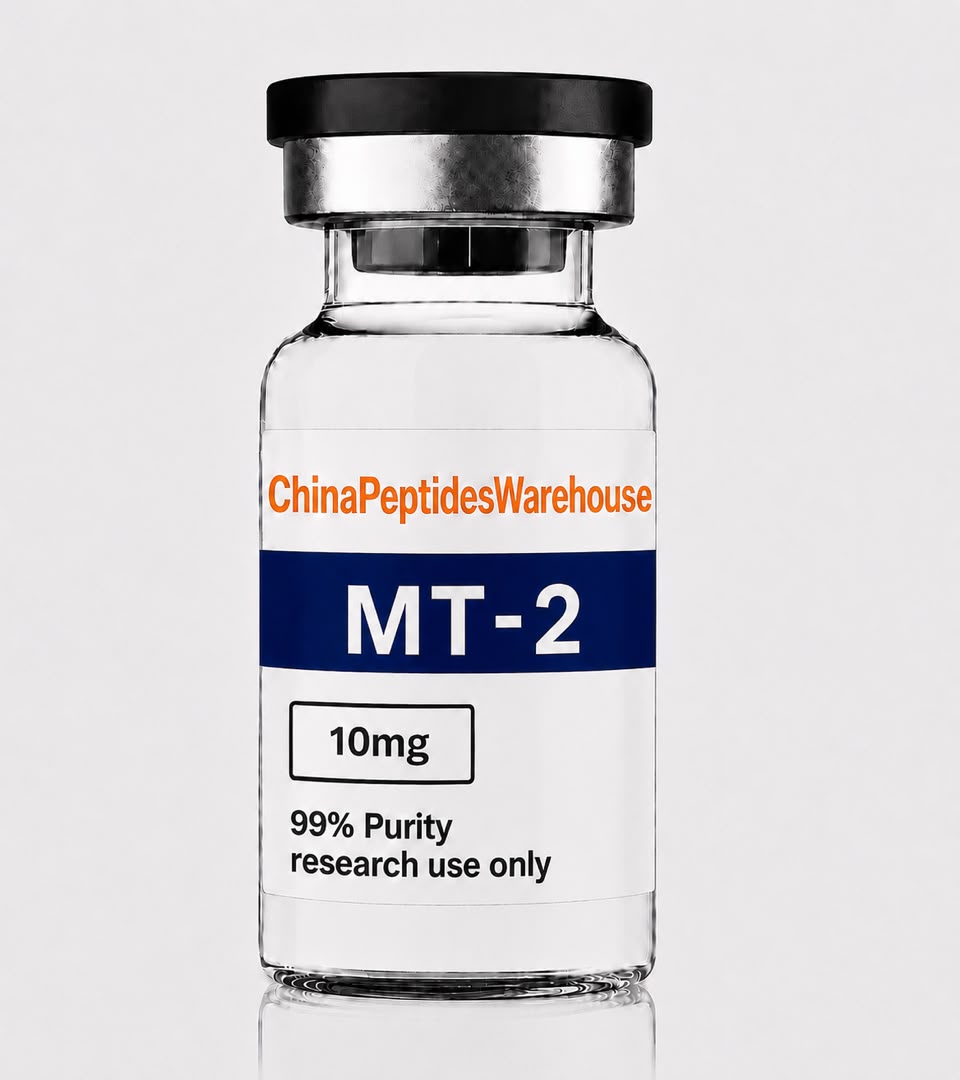
Buy MT-2 Online 10mg
$61.00
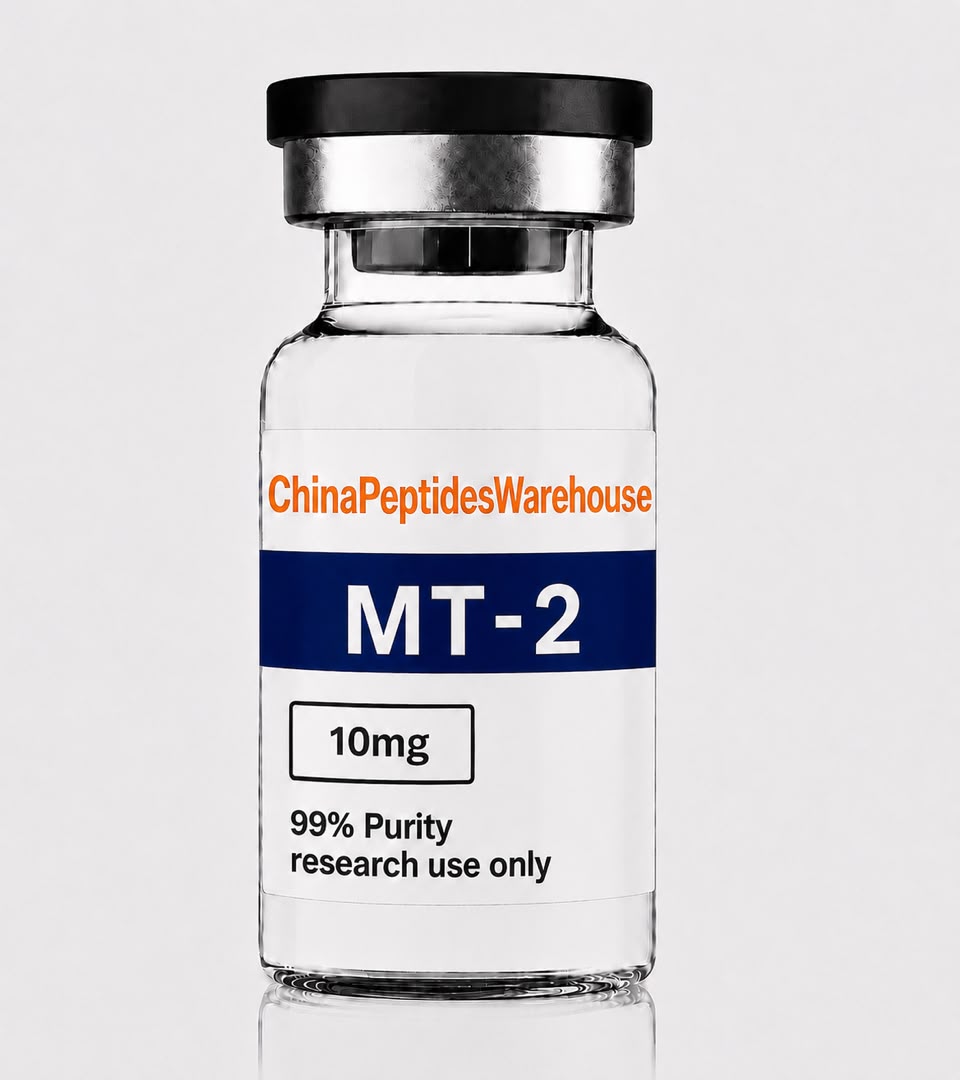
to MC1R on epidermal melanocytes, MT-2 stimulates the membrane-bound G-protein coupled receptor system. This triggers intracellular adenylate cyclase to convert ATP into cyclic AMP (cAMP). Elevated cAMP levels activate Protein Kinase A (PKA), driving expression of Microphthalmia-associated Transcription Factor (MITF). MITF upregulates the rate-limiting enzyme tyrosinase, accelerating the conversion of L-tyrosine into photoprotective eumelanin. This process increases melanin density within skin cells, providing a natural defense against ultraviolet (UV) radiation without requiring excessive sun exposure
(Melanotan-2) Cyclic Peptide Research Compound
Advanced Multi-Receptor Melanocortin Agonist for Photobiology, Melanogenesis, and Neurochemical Signaling Studies
Product Overview & Core Attributes
MT-2 (chemically designated as Ac-Nle-cyclo[Asp-His-D-Phe-Arg-Trp-Lys]-$\text{NH}_2$ or Melanotan-II) is a synthetic, cyclic lactam analogue of the naturally occurring peptide hormone $\alpha$-melanocyte-stimulating hormone ($\alpha$-MSH). Originally engineered at the University of Arizona to improve structural stability and receptor binding kinetics, MT-2 features a core heptapeptide sequence constrained into a lactam ring. This cyclic structure confers significant resistance against rapid enzymatic degradation by circulating endopeptidases, resulting in a prolonged biological half-life and potent physiological activity compared to linear peptides like native $\alpha$-MSH or MT-1.
Unlike narrow-spectrum analogues, the cyclic configuration of MT-2 enables non-selective full agonist binding across multiple central and peripheral melanocortin receptor subtypes, including MC1R, MC3R, MC4R, and MC5R. In scientific research and photobiological modeling, activation of cutaneous MC1R triggers intracellular adenylate cyclase, elevating cyclic AMP (cAMP) and upregulating tyrosinase activity to drive photoprotective eumelanin synthesis. Concurrently, activation of central nervous system MC3R and MC4R pathways influences central metabolic homeostasis, appetite regulation, and neurochemical pathways linked to sexual function.
Produced via automated solid-phase peptide synthesis (SPPS) and purified by reverse-phase HPLC, high-grade research material provides investigators with a reliable chemical tool for studying melanocortin signaling cascades, cellular photoprotection, and hypothalamic receptor pathways.
Key Technical Features:
-
Cyclic Lactam Structure: Constrained cyclic ring design enhances enzymatic resistance and structural stability compared to linear analogues.
-
Broad Melanocortin Agonism: Displays strong binding affinity across MC1R, MC3R, MC4R, and MC5R receptor subtypes.
-
Potent Melanogenesis Stimulation: Activates MC1R on cutaneous melanocytes to upregulate tyrosinase and increase photoprotective eumelanin production.
-
Central Systemic Activity: Crosses central signaling thresholds to interact with hypothalamic pathways involved in energy balance and neural signaling.
-
High Chemical Purity: Processed via RP-HPLC purification to achieve a chemical purity grade of $\ge 98.0\%$.
Technical & Chemical Specifications
The following analytical parameters define the core physicochemical properties of synthetic MT-2:
| Feature / Parameter | Analytical Specification |
| Chemical Name | Ac-Nle-cyclo[Asp-His-D-Phe-Arg-Trp-Lys]-$\text{NH}_2$ |
| Synonyms | Melanotan II, Melanotan-2, MT-II, Ac-Nle-c[Asp-His-D-Phe-Arg-Trp-Lys]-$\text{NH}_2$ |
| CAS Registry Number | 121062-08-6 |
| Molecular Formula | $\text{C}_{50}\text{H}_{69}\text{N}_{15}\text{O}_9$ |
| Molecular Weight | 1024.18 g/mol |
| Structural Architecture | Cyclic heptapeptide with lactam bridge bond between Asp² and Lys⁷ |
| Receptor Profile | Non-selective agonist (MC1R, MC3R, MC4R, MC5R) |
| Purity Standard | $\ge 98.0\%$ (determined by RP-HPLC and MS analysis) |
| Physical Form | Sterile lyophilized white to off-white cake/powder |
| Solubility | Soluble in sterile bacteriostatic water, deionized water, or PBS |
| Storage Temperature | Lyophilized powder stored desiccated at $-20^\circ\text{C}$ to $-80^\circ\text{C}$ |
Mechanism of Action & Physiological Signaling
The physiological effects of MT-2 stem from its ability to activate multiple melanocortin receptors simultaneously throughout peripheral tissues and the central nervous system.
                         +----------------------------------------+
                         |             Synthetic MT-2             |
                         |      (Cyclic Lactam Peptide)           |
                         +-------------------+--------------------+
                                             |
           +---------------------------------+---------------------------------+
           |                                                                   |
           v                                                                   v
+-----------------------+                                           +-----------------------+
|    Peripheral MC1R    |                                           |    Central MC3R/MC4R  |
|      Activation       |                                           |      Activation       |
+-----------+-----------+                                           +-----------+-----------+
            |                                                                   |
            v                                                                   v
+-----------------------+                                           +-----------------------+
|  Adenylate Cyclase &  |                                           | Hypothalamic Neural   |
|   cAMP Signal Casc.   |                                           | Signaling Pathways    |
+-----------+-----------+                                           +-----------+-----------+
            |                                                                   |
            v                                                                   v
+-----------------------+                                           +-----------------------+
| Tyrosinase Synthesis  |                                           | Modulation of Energy  |
|  & Eumelanin Shift    |                                           | Balance & Reflexes    |
+-----------+-----------+                                           +-----------+-----------+
            |                                                                   |
            +---------------------------------+---------------------------------+
                                              |
                                              v
                         +----------------------------------------+
                         |     Photoprotective Skin Pigmentation, |
                         |   Appetite & Metabolic Effects         |
                         +----------------------------------------+
1. Cutaneous Melanogenesis via MC1R Binding
When binding to MC1R on epidermal melanocytes, MT-2 stimulates the membrane-bound G-protein coupled receptor system. This triggers intracellular adenylate cyclase to convert ATP into cyclic AMP (cAMP). Elevated cAMP levels activate Protein Kinase A (PKA), driving expression of Microphthalmia-associated Transcription Factor (MITF). MITF upregulates the rate-limiting enzyme tyrosinase, accelerating the conversion of L-tyrosine into photoprotective eumelanin. This process increases melanin density within skin cells, providing a natural defense against ultraviolet (UV) radiation without requiring excessive sun exposure.
2. Hypothalamic Metabolic and Neural Signaling via MC3R & MC4R
Beyond pigment cell stimulation, MT-2 readily crosses central signaling barriers to bind MC3R and MC4R in the paraventricular nucleus of the hypothalamus. Central MC4R stimulation suppresses appetite and alters energy homeostasis pathways. At the same time, activation of central melanocortinergic pathways influences autonomic neural outputs involved in peripheral blood flow and sexual arousal responses.
Reconstitution & Handling Guidelines
Proper laboratory protocols must be maintained during the reconstitution and preparation of lyophilized MT-2 to prevent chemical denaturation and ensure experimental consistency.
+-------------------------------------------------------------------------+
|                    LABORATORY RECONSTITUTION STEPS                      |
+-------------------------------------------------------------------------+
| Step 1: Equilibrium   --> Allow vial to reach room temp (15-20 min)     |
| Step 2: Sterilization --> Clean rubber septum with 70% IPA swab         |
| Step 3: Diluent Intro --> Slow injection of Bacteriostatic Water        |
| Step 4: Solubilization--> Gentle circular swirling (DO NOT SHAKE)       |
| Step 5: Cold Storage  --> Store liquid at 2°C to 8°C (Refrigerated)     |
+-------------------------------------------------------------------------+
Equipment & Preparation Standard:
-
Lyophilized peptide vial (typically packaged at 10 mg concentration).
-
Reconstitution Diluent: Sterile Bacteriostatic Water (0.9% benzyl alcohol preserved).
-
Sterile 1 mL to 3 mL diluent syringes with 21G–27G needles.
-
Medical-grade 70% Isopropyl Alcohol (IPA) wipes.
Step-by-Step Reconstitution Protocol:
-
Temperature Stabilization: Remove the sealed vial from freezer storage ($-20^\circ\text{C}$) and allow it to sit at ambient room temperature for 15–20 minutes to prevent moisture condensation upon opening.
-
Septum Disinfection: Remove the protective plastic flip-off cap. Wipe the exposed rubber stopper with a 70% IPA swab and allow it to air-dry.
-
Adding Diluent: Draw up the desired volume of bacteriostatic water (e.g., 2.0 mL for a 10 mg vial yield). Insert the needle through the center of the rubber stopper at a slight angle.
-
Controlled Flow: Slow the needle plunge, aiming the fluid stream down the inside glass wall of the vial. Do not squirt liquid directly onto the lyophilized powder cake.
-
Dissolution: Allow the diluent to absorb into the powder mass. Gently roll the vial between your hands or tilt it in a slow circular motion until dissolved. Do not shake the vial vigorously, as high mechanical shear stress can disrupt peptide bonds.
-
Visual Check: Verify that the reconstituted solution is completely clear, colorless, and free of floating particles or cloudiness.
Storage Conditions & Temperature Stability
To prevent chemical hydrolysis and maintain structural integrity, adhere to the following temperature guidelines:
+--------------------------------------------------------------------+
|                  TEMPERATURE STABILITY MATRIX                      |
+--------------------------------------------------------------------+
|  Dry Powder (-20°C to -80°C)  | Stable for up to 36 Months         |
|  Dry Powder (Room Temp / 20°C)| Stable for 3-4 Weeks (Transit)     |
|  Reconstituted Liquid (2°-8°C)| Stable for up to 8 Weeks           |
|  Reconstituted Liquid (>25°C) | Degrades Rapidly (Avoid)           |
+--------------------------------------------------------------------+
-
Lyophilized Powder: Store unopened, dry vials at $-20^\circ\text{C}$ to $-80^\circ\text{C}$ in a dark, desiccated environment. Under freeze-storage conditions, the dry peptide maintains stability for up to 36 months.
-
Reconstituted Solution: Once mixed with preserved bacteriostatic water, store liquid vials refrigerated at $2^\circ\text{C}$ to $8^\circ\text{C}$. Use within 60 days to prevent gradual potency loss.
-
Light & Heat Protection: Keep vials protected from direct UV radiation and ambient light, as photon exposure can degrade tryptophan and tyrosine residues in the sequence.
Procurement Standards & Sourcing Guidance
When sourcing high-purity research materials or searching for reliable options to buy MT-2, prioritizing supplier verification and rigorous analytical testing helps guarantee quality and consistency.
+--------------------------------------------------------------------+
|                 PEPTIDE SOURCING QUALITY CHECKLIST                 |
+--------------------------------------------------------------------+
|  [x] RP-HPLC Analytical Purity Verification >= 98.0%               |
|  [x] Mass Spectrometry (MS) Confirming Exact Mass (1024.18 Da)     |
|  [x] Low Endotoxin & Residual Solvent Testing                      |
|  [x] Sealed Borosilicate Glass Vials with Vacuum Packaging         |
|  [!] AVOID: Sellers offering products without lot COA files        |
+--------------------------------------------------------------------+
1. Analytical COA Verification
Always demand a lot-specific Certificate of Analysis (COA) issued by an independent analytical testing laboratory. A complete COA must include:
-
RP-HPLC Chromatogram: Confirms purity percentage by measuring peak area integrity relative to synthesis byproducts.
-
Mass Spectrometry (ESI-MS or MALDI-TOF): Validates the exact molecular weight against the expected benchmark of 1024.18 Da.
-
Purity & Counterion Profile: Confirms acetate salt content and verifies minimal residual TFA or synthesis solvents.
2. Vendor Evaluation Standards
Research labs evaluating options to MT-2 buy shipments should favor suppliers that provide verified batch tracking and proper temperature-controlled packaging. Legitimate, high-purity MT-2 for sale online is distributed as a freeze-dried solid in vacuum-sealed glass vials to ensure stability throughout transport.
Customer & Researcher Reviews
Feedback and analytical observations from verified research laboratories, clinical specialists, and institutional researchers include:
“High Binding Efficiency & Batch-to-Batch Uniformity”
“Our research group utilizes this peptide for in vitro studies examining melanocortin receptor cross-talk in cell cultures. HPLC testing confirmed a batch purity of 98.8%, and the cyclic structure showed excellent resistance to degradation during extended incubation periods. The compound dissolved easily in bacteriostatic water without leaving residual particulates.”
— Dr. Henrik V., Lead Photobiology Researcher
“Consistent Results Across Receptor Assays”
“We evaluated this cyclic analogue alongside linear MSH variants to observe differences in cAMP pathway activation. The potency and signal duration of MT-2 were markedly higher, producing reliable and repeatable experimental data across multiple testing series. Vendor delivery was prompt, arriving in vacuum-sealed vials with cold packs intact.”
— Sarah T., Laboratory Specialist
“Reliable Quality Control Documentation”
“In our testing facility, lot verification is mandatory before starting any project. The supplier provided complete mass spectrometry and HPLC chromatograms matching our independent quality control checks. The structural stability and purity metrics have remained consistently high across all shipments.”
— David M., Institutional Operations Manager
Comprehensive Frequently Asked Questions (FAQ)
Q1: What distinguishes MT-2 from linear MT-1?
Linear MT-1 mimics native $\alpha$-MSH and acts selectively on the peripheral MC1R receptor. MT-2 features a cyclic lactam structure that enables binding across a broader range of melanocortin receptors, including MC1R, MC3R, MC4R, and MC5R. This broader receptor binding produces both peripheral tanning responses and central nervous system effects.
Q2: Which diluent should be used to dissolve the peptide powder?
Bacteriostatic Water (0.9% Benzyl Alcohol) is the recommended diluent for multi-use research applications, as the preservative prevents bacterial growth during cold storage. For single-use assays, sterile physiological saline or Phosphate-Buffered Saline (PBS) may be used instead.
Q3: How long does reconstituted MT-2 remain stable in storage?
When dissolved in bacteriostatic water and stored in a dark environment under refrigeration ($2^\circ\text{C}$ to $8^\circ\text{C}$), the liquid solution remains stable for 6 to 8 weeks. Avoid freezing reconstituted liquid solutions, as ice crystal formation can break delicate molecular bonds.
Q4: Why is cyclic peptide construction preferred over linear sequences?
Cyclic peptides are held together by internal lactam ring bonds that shield the amino acid chain from enzymatic degradation by exopeptidases and endopeptidases. This structural rigidity prolongs active half-life and increases receptor binding affinity.
Q5: What physical signs indicate peptide degradation?
Signs of chemical degradation include persistent cloudiness, discoloration, or floating particles in the reconstituted liquid. If the solution fails to clear after gentle swirling, discard the vial.
Q6: How does the compound promote melanogenesis?
By binding to MC1R on cutaneous melanocytes, the compound activates intracellular cAMP signaling, upregulating the enzyme tyrosinase. Tyrosinase converts L-tyrosine into insoluble eumelanin, increasing photoprotective pigmentation within the skin.
Q7: What analytical methods are used to verify purity?
Purity is verified using Reverse-Phase High-Performance Liquid Chromatography (RP-HPLC) to detect chemical impurities, while Electrospray Ionization Mass Spectrometry (ESI-MS) confirms exact molecular mass.
Summary & Final Takeaways
The MT-2 cyclic peptide remains an essential research tool in photobiology, endocrinology, and neurochemical receptor modeling. Its cyclic structural design delivers superior enzymatic stability compared to linear peptides, while its broad agonism across MC1R, MC3R, MC4R, and MC5R enables comprehensive investigation of melanocortin signaling pathways.
When procuring material for scientific use, select suppliers that provide complete third-party COA validation, HPLC purity verification, and proper temperature-controlled shipping to ensure consistent experimental results.
Reviews
There are no reviews yet.