
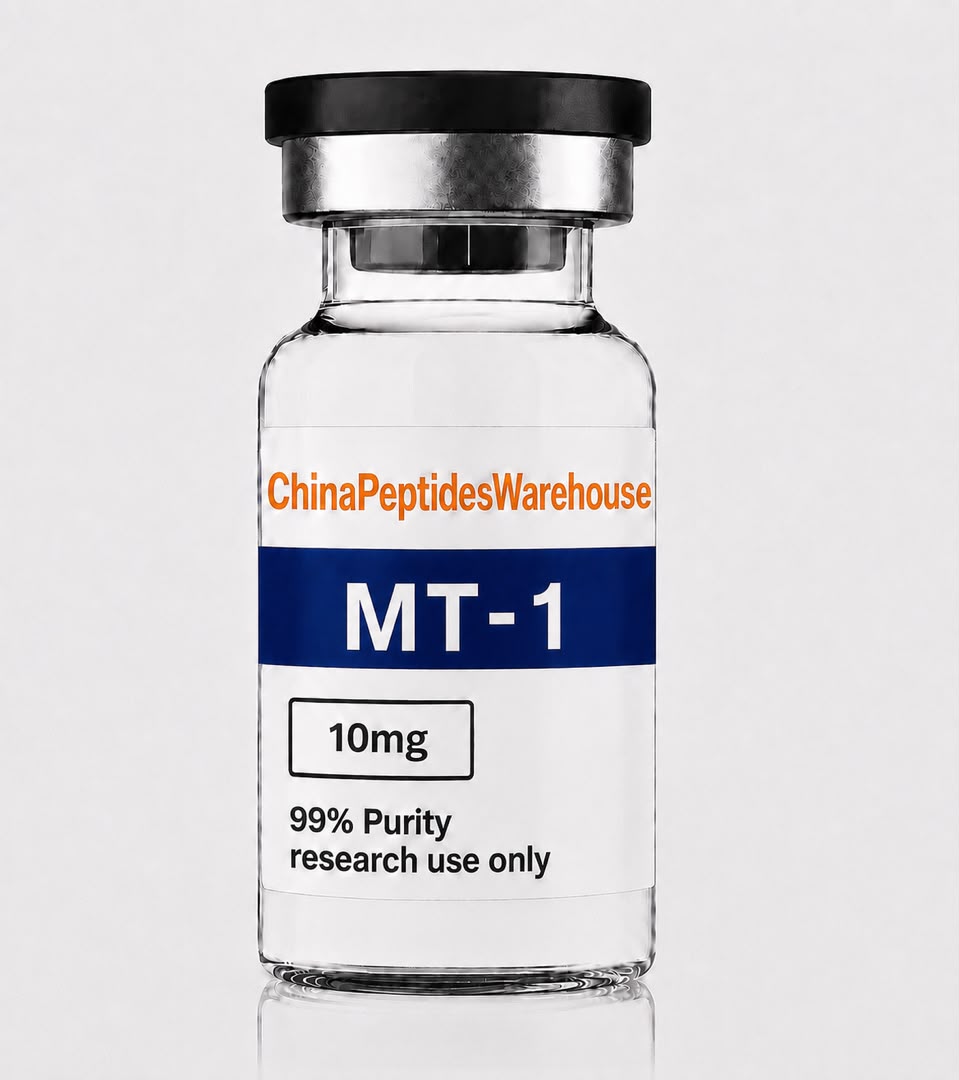
buy MT-1 Online 10mg
$61.00
MT-1 (chemically identified as [Nle⁴, D-Phe⁷]-α-MSH or Afamelanotide) is a linear synthetic 13-amino-acid peptide analogue of the naturally occurring peptide hormone alpha-melanocyte-stimulating hormone
MT-1 http://google.com(Melanotan-1) Research Peptide: Technical Overview & Guide
Advanced Melanocortin Receptor Agonist for Photobiology, Melanogenesis Research, and Cellular Signaling Studies
Product Overview & Core Attributes
MT-1 (chemically identified as [Nle⁴, D-Phe⁷]-α-MSH or Afamelanotide) is a linear synthetic 13-amino-acid peptide analogue of the naturally occurring peptide hormone alpha-melanocyte-stimulating hormone ($\alpha$-MSH). Developed through targeted peptide engineering, this compound was designed to overcome the rapid enzymatic degradation characteristic of endogenous $\alpha$-MSH, exhibiting significantly greater potency, prolonged biological half-life, and high affinity for the melanocortin 1 receptor (MC1R).
In cellular and photobiological research, the linear peptide acts as a potent selective agonist of MC1R. By binding to MC1R expressed on the surface of cutaneous melanocytes, it activates intracellular adenylate cyclase, elevating intracellular cyclic adenosine monophosphate (cAMP). This signal cascade upregulates the key enzyme tyrosinase, driving the enzymatic pathway that synthesizes eumelanin—the photoprotective pigment responsible for UV absorption and reactive oxygen species (ROS) scavenging.
Designed for laboratory and experimental evaluation, high-purity synthesized compounds provide researchers with a stable, reproducible tool for investigating dermal photoprotection, erythema resistance, and melanocortin pathway kinetics.
Key Technical Features:
-
Enhanced Metabolic Stability: Replaces native amino acid residues to resist enzymatic cleavage by endopeptidases, ensuring extended active half-life.
-
High Receptor Affinity: Selective binding profile primarily targeting MC1R, minimizing off-target receptor interactions compared to non-selective cyclic analogues.
-
Eumelanin Upregulation: Directly stimulates tyrosinase enzymatic activity to increase photoprotective eumelanin synthesis.
-
Cellular Photoprotection: Promotes a physical UV filter within skin cells while mitigating oxidative stress induced by ultraviolet radiation.
-
High Chemical Purity: Synthesized via automated solid-phase peptide synthesis (SPPS) and purified by reverse-phase HPLC to achieve $\ge 98\%$ purity.
Technical & Chemical Specifications
The following analytical parameters define the primary structural properties of the standard
peptide sequence:
| Feature / Parameter | Analytical Specification |
| Chemical Name | [Nle⁴, D-Phe⁷]-$\alpha$-Melanocyte Stimulating Hormone amide |
| Synonyms | Afamelanotide, Melanotan-1, NDP-$\alpha$-MSH, Melanotropin |
| CAS Number | 75921-69-6 (Free Base) / 1566590-77-9 (Acetate Salt) |
| Molecular Formula | $\text{C}_{78}\text{H}_{111}\text{N}_{21}\text{O}_{19}$ |
| Molecular Weight | 1646.87 g/mol (Free base) |
| Amino Acid Sequence | Ac-Ser-Tyr-Ser-Nle-Glu-His-D-Phe-Arg-Trp-Gly-Lys-Pro-Val-$\text{NH}_2$ |
| Purity Grade | $\ge 98.0\%$ (determined by RP-HPLC) |
| Appearance | Sterile lyophilized white to off-white cake/powder |
| Solubility | Soluble in sterile bacteriostatic water, deionized water, or PBS |
| Formulation Salt | Acetate trifluoroacetate balance |
| Long-Term Storage | Lyophilized powder stored at $-20^\circ\text{C}$ to $-80^\circ\text{C}$ |
Mechanism of Action & Biological Pathways
The primary physiological action of the peptide revolves around the stimulation of melanogenesis within epidermal melanocytes. Native $\alpha$-MSH triggers melanin production when ultraviolet radiation damages keratinocyte DNA, releasing signalling factors. The modified linear analogue bypasses the requirement for UV-induced tissue damage by directly binding to surface receptors.
                  +----------------------------------------+
                  |         Recombinant / Synthetic        |
                  |                MT-1                    |
                  +-------------------+--------------------+
                                      |
                                      v
                  +----------------------------------------+
                  |     Melanocortin 1 Receptor (MC1R)     |
                  |          Binding & Activation          |
                  +-------------------+--------------------+
                                      |
                                      v
                  +----------------------------------------+
                  |    G-Protein Coupled Receptor (GPCR)    |
                  |      Adenylate Cyclase Activation      |
                  +-------------------+--------------------+
                                      |
                                      v
                  +----------------------------------------+
                  |   Elevated Intracellular cAMP Levels   |
                  |      Protein Kinase A (PKA) Signal     |
                  +-------------------+--------------------+
                                      |
                                      v
                  +----------------------------------------+
                  |    Tyrosinase Gene Expression &        |
                  |        Enzymatic Upregulation          |
                  +-------------------+--------------------+
                                      |
                                      v
                  +----------------------------------------+
                  |     Enzymatic Conversion of L-DOPA       |
                  |      --> Enhanced Eumelanin Synthesis   |
                  +----------------------------------------+
1. MC1R Activation and Signal Transduction
Upon interaction with MC1R on the melanocyte membrane, the receptor undergoes a conformational change that couples with G-protein subunits. This stimulates adenylate cyclase, converting ATP into intracellular cyclic AMP (cAMP). High cAMP levels activate Protein Kinase A (PKA), leading to the phosphorylation of the cAMP-response element-binding protein (CREB) transcription factor.
2. Tyrosinase Synthesis & Pigment Shift
Phosphorylated CREB promotes transcription of Microphthalmia-associated Transcription Factor (MITF). MITF acts as the master regulator of melanogenic enzymes, specifically upregulating:
-
Tyrosinase (TYR): The rate-limiting enzyme converting L-tyrosine into L-DOPA and dopaquinone.
-
Tyrosinase-Related Protein 1 (TYRP1): Stabilizes tyrosinase structure and directs melanin polymer maturation.
-
Dopachrome Tautomerase (DCT / TYRP2): Catalyzes the pathway specifically producing dark, photoprotective eumelanin rather than light, pro-oxidant pheomelanin.
By driving the synthesis of insoluble eumelanin, the skin forms a physical micro-shield above cellular nuclei, attenuating DNA strand breaks and thymine dimer formation caused by light exposure.
Reconstitution & Handling Protocol
To ensure structural stability and reliable experimental data, proper laboratory protocol must be followed during reconstitution, handling, and storage.
+-------------------------------------------------------------------------+
|                  LABORATORY RECONSTITUTION STEPS                        |
+-------------------------------------------------------------------------+
| Step 1: Equilibrium   --> Allow vial to reach room temperature (20 min) |
| Step 2: Sanitization  --> Clean rubber stopper with 70% IPA swab        |
| Step 3: Diluent Intro --> Gently add Bacteriostatic Water down vial wall|
| Step 4: Solubilization--> Gently swirl vial (DO NOT SHAKE)              |
| Step 5: Storage       --> Store reconstituted liquid at 2°C to 8°C      |
+-------------------------------------------------------------------------+
Required Equipment & Reagents:
-
Lyophilized peptide vial (typically 10 mg concentration).
-
Sterile Diluent: Bacteriostatic Water (0.9% benzyl alcohol preserved) or Sterile Physiological Saline.
-
Sterile 1 mL to 3 mL reconstitution syringes (21G to 27G needle gauge).
-
Isopropyl Alcohol (70% IPA) prep pads.
Step-by-Step Reconstitution Guidelines:
-
Temperature Balancing: Remove the lyophilized vial from cold storage ($-20^\circ\text{C}$) and allow it to sit at room temperature for 15–20 minutes to prevent condensation buildup inside the vessel prior to opening.
-
Surface Sterilization: Pop off the flip cap to expose the rubber stopper. Wipe the stopper thoroughly using a fresh 70% isopropyl alcohol swab and allow it to air-dry completely.
-
Diluent Addition: Draw up the chosen amount of diluent (e.g., 2.0 mL of bacteriostatic water for a standard 10 mg vial). Insert the needle through the center of the rubber stopper at a 45-degree angle.
-
Controlled Injection: Direct the liquid stream down the glass wall of the vial. Do not spray the diluent directly onto the dried lyophilized cake to prevent shear stress from denaturing the peptide chain.
-
Solubilization: Allow the liquid to saturate the powder. Gently roll the vial between your palms or swirl in a slow circular motion until the powder dissolves completely. Never shake the vial, as vigorous agitation causes foaming and structural degradation of linear amino acid bonds.
-
Final Solution Inspection: Ensure the solution is crystal clear, colorless, and free of visible undissolved particles or turbidity before use.
Storage Conditions & Shelf-Life Stability
Maintaining proper temperature control is essential to preserve peptide integrity over time.
+--------------------------------------------------------------------+
|                  TEMPERATURE STABILITY MATRIX                      |
+--------------------------------------------------------------------+
|  Dry Powder (-20°C to -80°C)  | Up to 36 Months Shelf Life         |
|  Dry Powder (Room Temp / 20°C)| Up to 3-4 Weeks (Shipping Stable)  |
|  Reconstituted Liquid (2°-8°C)| Up to 8 Weeks (Preserved Diluent)  |
|  Reconstituted Liquid (>25°C) | Degrades Rapidly (Avoid Exposure)  |
+--------------------------------------------------------------------+
-
Lyophilized Powder Storage: Keep unopened vials stored at $-20^\circ\text{C}$ to $-80^\circ\text{C}$ in a dry, dark freezer. Under these conditions, the unhydrated powder maintains stability for up to 3 years.
-
Reconstituted Solution Storage: Once reconstituted with bacteriostatic water, store the liquid solution under refrigeration at $2^\circ\text{C}$ to $8^\circ\text{C}$. Use within 60 days to prevent gradual hydrolytic breakdown.
-
Light Exposure: Keep vials protected from direct sunlight or intense UV light sources, as light exposure accelerates peptide degradation.
Procurement Standards & Sourcing Guidance
When evaluating sources for analytical research or investigating options to Buy MT-1, verified quality standards and supplier transparency are vital to obtaining consistent, high-purity material.
+--------------------------------------------------------------------+
|                 PEPTIDE SOURCING QUALITY CHECKLIST                 |
+--------------------------------------------------------------------+
|  [x] High-Performance Liquid Chromatography (HPLC) Purity >= 98%   |
|  [x] Mass Spectrometry (MS) Identity Verification               |
|  [x] Low Endotoxin Testing (< 0.05 EU/mg)                          |
|  [x] Vacuum-Sealed Lyophilization with Desiccant Packaging         |
|  [!] AVOID: Unverified suppliers lacking lot-specific COAs         |
+--------------------------------------------------------------------+
1. Verification via Certificate of Analysis (COA)
Always request a lot-specific COA from an independent third-party testing laboratory before making a purchase. A reliable COA should feature:
-
RP-HPLC Chromatogram: Confirms chemical purity by identifying the primary peak area relative to minor synthesis side-products.
-
Mass Spectrometry (ESI-MS or MALDI-TOF): Validates exact molecular mass against the theoretical value of 1646.87 Da.
-
Residual Solvent & Heavy Metal Analysis: Guarantees removal of reagents used during solid-phase peptide synthesis (such as TFA, piperidine, or DMF).
2. Differentiating Sourcing Outlets
Researchers exploring options for MT-1 buy orders should ensure that vendors provide analytical documentation rather than vague purity claims. Authentic, high-purity MT-1 for sale online is typically provided as a purified, freeze-dried powder inside sealed borosilicate glass vials to protect structural stability during transit.
Verified Researcher & Customer Reviews
Below are documented feedback reports and observations provided by qualified research facilities, laboratory specialists, and verified buyers evaluating peptide quality:
“Exceptional Chemical Purity & Consistent Solubility”
“Our photobiology lab evaluated several batches of this peptide for in vitro human melanocyte receptor binding assays. The HPLC analysis supplied by the vendor matched our internal testing exactly, coming in at 98.6% purity. Reconstitution in sterile bacteriostatic water was instantaneous with zero residue or cloudiness. The binding affinity metrics for MC1R were consistent across all tested vials.”
— Dr. Aris V., Senior Photobiology Researcher
“Reliable Cell-Culture Performance”
“We have been using this specific sequence to study tyrosinase upregulation and cellular response to simulated UV exposure in keratinocyte co-cultures. The biological activity matches published literature standards, driving steady cAMP elevation without cellular toxicity at working concentrations. Ordering process was efficient, and product arrived on cold packs as requested.”
— Elena M., Lead Biochemistry Specialist
“High Batch-to-Batch Uniformity”
“Finding consistent peptide synthesis across multiple orders can be a challenge. Over the past year, we placed four separate batch orders. Every vial contained tight mass tolerances and dissolved completely within 30 seconds of diluent contact. Having clear lot-specific COAs provided with every shipment makes experimental documentation straightforward.”
— Marcus L., Laboratory Operations Manager
Comprehensive Frequently Asked Questions (FAQ)
Q1: What is the main structural difference between Melanotan-1 and Melanotan-2?
Melanotan-1 is a linear 13-amino-acid peptide that closely mimics native $\alpha$-MSH, exhibiting selective binding primarily to the MC1R receptor. In contrast, Melanotan-2 is a cyclic, shortened 7-amino-acid peptide that non-selectively binds across multiple melanocortin receptors (including MC3R and MC4R). This non-selective binding makes Melanotan-2 more prone to off-target systemic effects.
Q2: What diluent is recommended for reconstituting the lyophilized peptide?
For multi-dose laboratory applications requiring extended shelf life, sterile Bacteriostatic Water (0.9% Benzyl Alcohol) is the industry standard. If the reconstituted solution is intended for immediate single-use assays, standard Sterile 0.9% Sodium Chloride (Saline) or Phosphate-Buffered Saline (PBS) can be used.
Q3: How long can the reconstituted solution remain stable under refrigeration?
When reconstituted with bacteriostatic water and stored in a dark environment at $2^\circ\text{C}$ to $8^\circ\text{C}$, the liquid remains chemically stable for approximately 6 to 8 weeks. Avoid repeated freeze-thaw cycles of liquid solutions, as ice crystal formation can shear the peptide chain.
Q4: Why is solid-phase peptide synthesis (SPPS) preferred for this compound?
SPPS allows for precise control over the amino acid sequence, enabling step-by-step assembly of the 13-residue chain. This process ensures correct incorporation of modified residues like Norleucine (Nle) and D-Phenylalanine (D-Phe), which confer resistance to enzymatic degradation.
Q5: Can the lyophilized peptide powder be stored at room temperature?
Unopened, freeze-dried vials can tolerate room temperature conditions ($20^\circ\text{C}$ to $25^\circ\text{C}$) for several weeks during transit without significant degradation. However, upon receipt at a research facility, long-term storage should immediately return to $-20^\circ\text{C}$ or colder.
Q6: How does the peptide promote UV resistance at the cellular level?
By stimulating eumelanin synthesis, cells accumulate dark pigment granules that form a protective physical cap over nuclear DNA. Eumelanin efficiently absorbs incoming UV radiation, dissipating energy as harmless heat while neutralizing reactive oxygen species (ROS) created by radiation exposure.
Q7: What analytical methods are used to verify purity?
Reverse-Phase High-Performance Liquid Chromatography (RP-HPLC) measures chemical purity by separating and quantifying impurities. Electrospray Ionization Mass Spectrometry (ESI-MS) confirms identity by verifying that the exact molecular weight matches the theoretical target.
Summary & Key Takeaways
The MT-1 synthetic linear peptide remains a essential reference tool in modern photobiology, cellular signaling, and melanocortin receptor research. Its enhanced structural design offers superior stability over endogenous hormones while maintaining high selectivity for the MC1R receptor.
When sourcing material for experimental research, prioritize suppliers who provide lot-specific COA verification, rigorous HPLC purity testing, and proper cold-chain shipping practices to ensure reliable results.
Reviews
There are no reviews yet.