
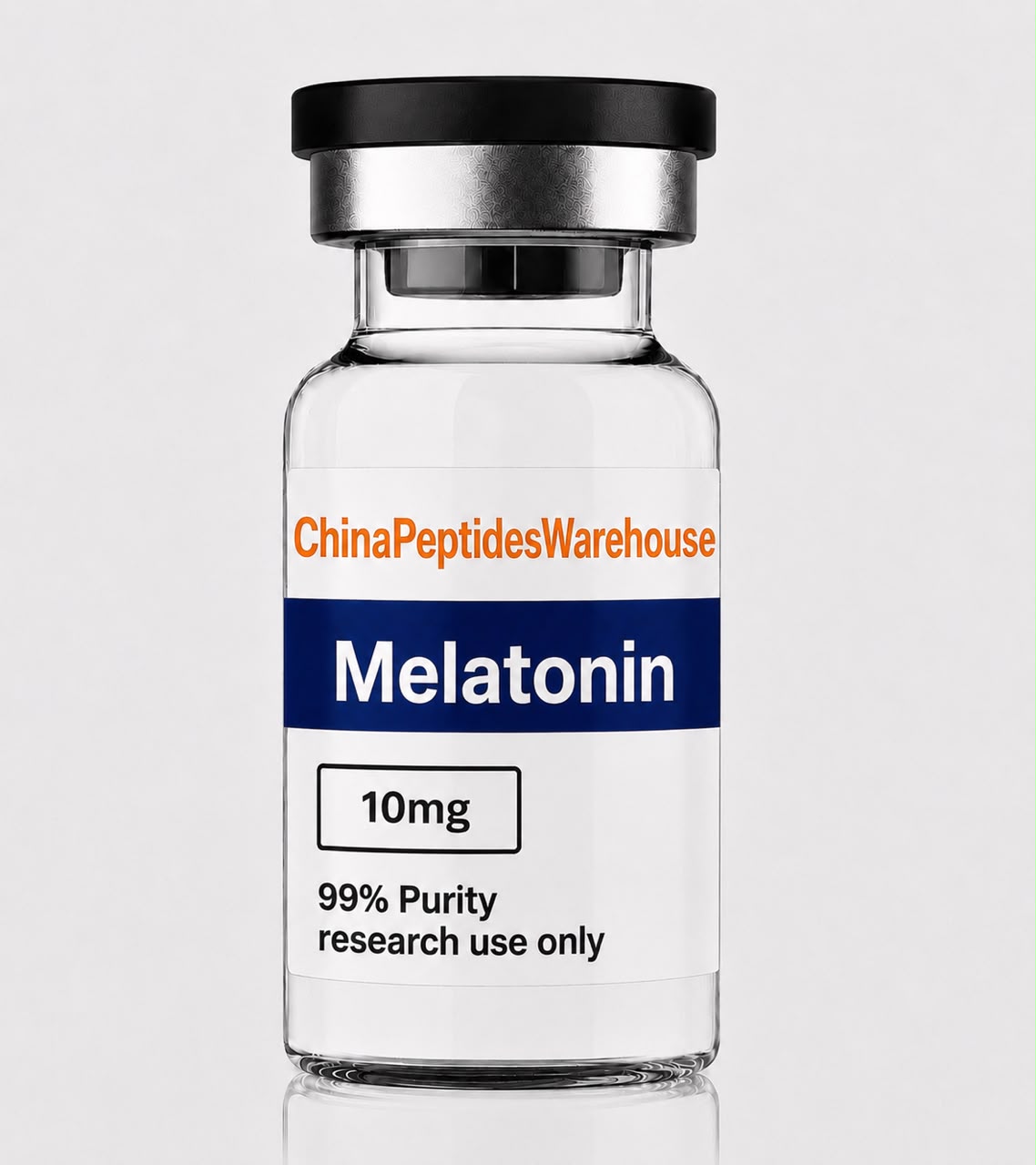
Buy Melatonin 10mg
$72.00
($N\text{-acetyl-5-methoxytryptamine}$) is a naturally occurring neurohormone primarily synthesized and secreted by the pineal gland in response to darkness
Melatonin Circadian & Sleep Synchronization Guide
Advanced Chronobiological Hormone Support for Restful Sleep, Internal Clock Alignment, and Cellular Protection
Product Overview & Core Attributes
Melatonin ($N\text{-acetyl-5-methoxytryptamine}$) is a naturally occurring neurohormone primarily synthesized and secreted by the pineal gland in response to darkness. Known as the body’s master “hormone of darkness,” Melatonin plays a critical role in entraining and stabilizing the human circadian rhythm—the internal biological clock that regulates the sleep-wake cycle, core body temperature, hormone output, and metabolic recovery.
Exogenous Melatonin supplementation serves as a precise chronobiotic tool. Unlike heavy sedatives or central nervous system depressants that induce artificial sleep architecture, Melatonin acts directly on endogenous G-protein-coupled receptors in the brain to signal the natural onset of sleep. It decreases sleep onset latency (the time required to fall asleep), enhances sleep duration, and helps realign internal rhythms disrupted by shift work, jet lag, modern screen exposure, or age-related declines in hormone synthesis.
Synthesized to USP/pharmaceutical-grade standards, high-purity Melatonin delivers dependable bioavailability and predictable dosing. Beyond its central role in sleep regulation, Melatonin is one of the body’s most potent endogenous antioxidants. It neutralizes free radicals, protects mitochondrial DNA from oxidative stress, and supports immune system homeostasis.
Key Performance Highlights:
-
Circadian Phase Entrainment: Re-synchronizes disrupted sleep-wake cycles caused by travel across time zones, irregular shifts, or late-phase sleep syndrome.
-
Sleep Latency Reduction: Accelerates the transition from wakefulness to stage-1 sleep without altering natural REM and slow-wave sleep stages.
-
Potent Cellular Antioxidant: Crosses all biological barriers, including the blood-brain barrier, to scavenge reactive oxygen species (ROS) and support mitochondrial health.
-
Non-Habit Forming Architecture: Does not suppress endogenous hormone recovery or cause physical dependence, tolerance, or rebound insomnia when used as directed.
-
Cardiometabolic & Immune Support: Helps regulate nighttime blood pressure, metabolic signaling, and nocturnal immune system repair.
Technical & Pharmacological Specifications
Review the chemical, structural, and physiological specifications defining medical-grade Melatonin:
| Feature / Parameter | Analytical Specification |
| Chemical Name | $N\text{-[2-(5-methoxy-1H-indol-3-yl)ethyl]acetamide}$ |
| CAS Registry Number | 73-31-4 |
| Molecular Formula | $\text{C}_{13}\text{H}_{16}\text{N}_2\text{O}_2$ |
| Molecular Weight | 232.28 g/mol |
| Pharmacological Class | Chronobiotic / Direct Receptor Agonist ($\text{MT}_1$, $\text{MT}_2$) |
| Primary Receptors | $\text{MT}_1$ (Sleep onset), $\text{MT}_2$ (Circadian phase shift) |
| Purity Grade | $\ge 99.0\%$ Ultra-Pure Synthetic Grade (USP Standard) |
| Formulation Profiles | Immediate Release (IR), Dual-Release, Extended Release (XR) |
| Biological Half-Life | 20 to 50 minutes (rapid hepatic clearance) |
| Bioavailability | ~15% (due to first-pass liver metabolism) |
| Storage Requirements | Store tight-sealed in a cool, dry place protected from light ($15^\circ\text{C}$ to $25^\circ\text{C}$) |
How Melatonin Works: The Chronobiotic Pathway
The biological activity of Melatonin is mediated through two high-affinity membrane receptors—$\text{MT}_1$ and $\text{MT}_2$—located within the suprachiasmatic nucleus (SCN) of the anterior hypothalamus, the body’s master circadian clock.
                 +----------------------------------------+
                 |            Light Deprivation           |
                 |       (Retinal Photoreceptors Off)     |
                 +-------------------+--------------------+
                                     |
                                     v
                 +----------------------------------------+
                 |     Suprachiasmatic Nucleus (SCN)      |
                 |      Signals Pineal Gland Synthesis    |
                 +-------------------+--------------------+
                                     |
                                     v
                 +----------------------------------------+
                 |      Melatonin Receptor Binding        |
                 |       (MT1 and MT2 Subtypes)           |
                 +-------------------+--------------------+
                                     |
           +-------------------------+-------------------------+
           |                                                   |
           v                                                   v
+-----------------------+                           +-----------------------+
|     MT1 Activation    |                           |     MT2 Activation    |
|   (Hypnotic Effect)   |                           | (Chronobiotic Shift)  |
+-----------+-----------+                           +-----------+-----------+
            |                                                   |
            v                                                   v
  Suppresses Neuronal                                 Advances or Delays
  Firing in SCN -->                                   Circadian Phase -->
  Reduces Core Temp &                                Aligning Biological
  Promotes Sleep Onset                                 Internal Clock
            |                                                   |
            +--------------------+------------------------------+
                                 |
                                 v
            +------------------------------------------+
            |   Natural Sleep Transition, Balanced     |
            |     Metabolism & Restorative Sleep       |
            +------------------------------------------+
1. $\text{MT}_1$ Receptor Signaling (Sleep Onset)
Activation of the $\text{MT}_1$ receptor reduces electrical firing rates within SCN neurons. This decrease in central activity lowers core body temperature, reduces peripheral vascular resistance, and induces the physiological drive needed to fall asleep smoothly.
2. $\text{MT}_2$ Receptor Signaling (Clock Entrainment)
Activation of the $\text{MT}_2$ receptor controls circadian phase shifting. Administered at specific times relative to the body’s natural dim-light melatonin onset (DLMO), Melatonin can either advance or delay the internal clock. Taking it in the early evening shifts the clock earlier (helping night owls fall asleep sooner), while morning administration shifts the clock later.
Dosing Protocols & Usage Guidelines
When introducing Melatonin, timing and proper dosage are key to achieving optimal sleep outcomes. Unlike conventional supplements where higher doses equal stronger effects, chronobiotic supplements work best at low, physiologically accurate levels.
+-------------------------------------------------------------------------+
|                    MELATONIN STRATEGIC DOSING MATRIX                    |
+-------------------------------------------------------------------------+
| Micro-Dose (0.3 mg - 1 mg) --> Physiological replacement & sensitivity  |
| Standard Dose (1 mg - 3 mg) --> General sleep onset & jet lag phase    |
| Clinical Target (3 mg - 5 mg)--> Shift work & significant circadian shifts|
+-------------------------------------------------------------------------+
Recommended Dosing Schedules
-
Micro-Dosing / Physiological Balance (0.3 mg to 1 mg):
-
Target Use: Restoring natural hormone levels, light sleep disturbances, age-related synthesis decline, or sensitive individuals.
-
Timing: Take 60 to 90 minutes before your target bedtime.
-
-
Standard Sleep Onset Protocol (1 mg to 3 mg):
-
Target Use: Difficulty falling asleep, modern blue-light exposure recovery, or mild sleep cycle adjustments.
-
Timing: Take 30 to 60 minutes before going to bed.
-
-
Jet Lag & Circadian Realignment Protocol (3 mg to 5 mg):
-
Target Use: Eastbound travel across multiple time zones, rotating work shifts, or severe phase delays.
-
Timing: Take at target bedtime in your destination time zone for 3 to 5 consecutive days.
-
Administration Best Practices:
-
Environment Optimization: Ensure your bedroom is dark, quiet, and cool ($15^\circ\text{C}$ to $19^\circ\text{C}$). Melatonin signals sleep, but bright light (especially blue light from screens) can counteract its effects.
-
Consistency: Take your chosen dose at the exact same time each evening to give your brain a stable circadian anchor.
Sourcing Standards & Safe Procurement
Navigating where to order high-quality supplements requires evaluating purity, regulatory compliance, and verified testing parameters.
+--------------------------------------------------------------------+
|                  SAFE SOURCING QUALITY CHECKLIST                   |
+--------------------------------------------------------------------+
|  [x] Analytical Certificate of Analysis (COA) confirming HPLC      |
|  [x] USP / Pharmaceutical Purity Standard Grade (>= 99%)           |
|  [x] Verifiable Heavy Metal, Pesticide, and Microbial Screening     |
|  [x] Free of Synthetic Fillers, Artificial Colors, and Gluten      |
|  [!] AVOID: Unverified suppliers lacking third-party verification  |
+--------------------------------------------------------------------+
Choosing Medical-Grade Sourcing
Because over-the-counter supplement quality can vary, individuals looking for reliable sources to buy Melatonin should focus on lab-verified formulations. Independent studies show that unverified products often contain variable amounts of active ingredients or undisclosed additives. When evaluating options to purchase Melatonin buy orders or reviewing certified Melatonin for sale online, ensure the manufacturer provides lot-specific testing to confirm ingredient accuracy and purity.
Verified Customer & Clinical Testimonials
“Restored My Natural Sleep Rhythm Without Morning Grogginess”
“After years of working late shifts and staring at computer monitors, my body clock was completely off track. I struggled to fall asleep before 3 AM. Switching to a low 1.5 mg dual-release Melatonin protocol 45 minutes before my goal bedtime was a game changer. Within ten days, my body naturally started feeling sleepy around 10:30 PM. Best of all, I wake up clear-headed without the heavy brain fog that prescription sleep aids used to cause.”
— Sarah K., Software Engineer
“Essential Support for Frequent International Travel”
“Crossing multiple time zones monthly for business used to leave me exhausted for days. Using a structured 3 mg Melatonin protocol upon landing at my destination bedtime shortened my jet lag recovery dramatically. It’s an indispensable part of my travel routine.”
— David M., Global Operations Consultant
“Consistent Quality & Measurable Results”
“As a clinician evaluating dietary supplements, purity and verified dosing are my top priorities. The standardized HPLC testing for this formulation provides total confidence. My patients consistently report smoother sleep onset and improved morning alertness when combining this supplement with basic sleep hygiene.”
— Dr. Elena R., Integrative Health Specialist
Frequently Asked Questions (FAQ)
Q1: Will taking exogenous Melatonin cause my body to stop making its own naturally?
Clinical studies show that short- to medium-term supplementation with low-to-moderate doses of Melatonin does not permanently suppress endogenous pineal gland production. Unlike anabolic steroids or thyroid hormones, Melatonin does not operate on a rigid negative feedback loop that shuts down natural hormone synthesis.
Q2: Why do higher doses sometimes cause vivid dreams or morning drowsiness?
Taking excess amounts (such as 10 mg or more) can over-saturate brain receptors. This keeps active hormone levels elevated into the morning, leading to vivid dreams, light waking, or daytime sluggishness. If you experience these side effects, lower your daily dose to 0.5 mg–1 mg.
Q3: What is the difference between Immediate Release and Extended Release formulations?
-
Immediate Release (IR): Rapidly releases active ingredients into the bloodstream within 20 to 30 minutes. Best for people who have trouble falling asleep.
-
Extended Release (XR): Mimics the body’s natural nocturnal secretion profile by slowly releasing the hormone over 5 to 7 hours. Best for people who fall asleep easily but wake up throughout the night.
Q4: Can I combine Melatonin with other natural sleep aids?
Yes. Melatonin pairs well with non-sedating, relaxing compounds like L-Theanine, Magnesium Glycinate, Ashwagandha, or Chamomile. These ingredients help calm central nervous system activity, complementing the chronobiotic phase-shifting signal of Melatonin.
Q5: Is Melatonin safe for long-term daily use?
Research indicates that long-term supplementation at reasonable physiological doses (0.5 mg to 3 mg) has a strong safety profile in adults, showing no habit-forming effects or significant risk of dependency. However, it is always a good idea to periodically reassess your sleep needs with a healthcare professional.
Q6: How long before bed should I take my dose?
For general sleep onset support, take your supplement 30 to 60 minutes before your target bedtime. For shifting your overall sleep cycle earlier, take low doses 2 to 4 hours before your usual dim-light onset time.
Summary & Final Takeaways
Melatonin remains an effective, science-backed option for managing modern sleep disruptions, realigning circadian rhythms, and protecting cellular health. By aligning supplementation timing with your body’s natural physiology and choosing low, accurate doses, you can establish healthy, restorative sleep patterns without relying on habit-forming pharmaceuticals.
For best results, pair your supplementation with good sleep habits—such as limiting evening screen time, keeping your bedroom dark, and maintaining a consistent wake-up schedule.
Reviews
There are no reviews yet.