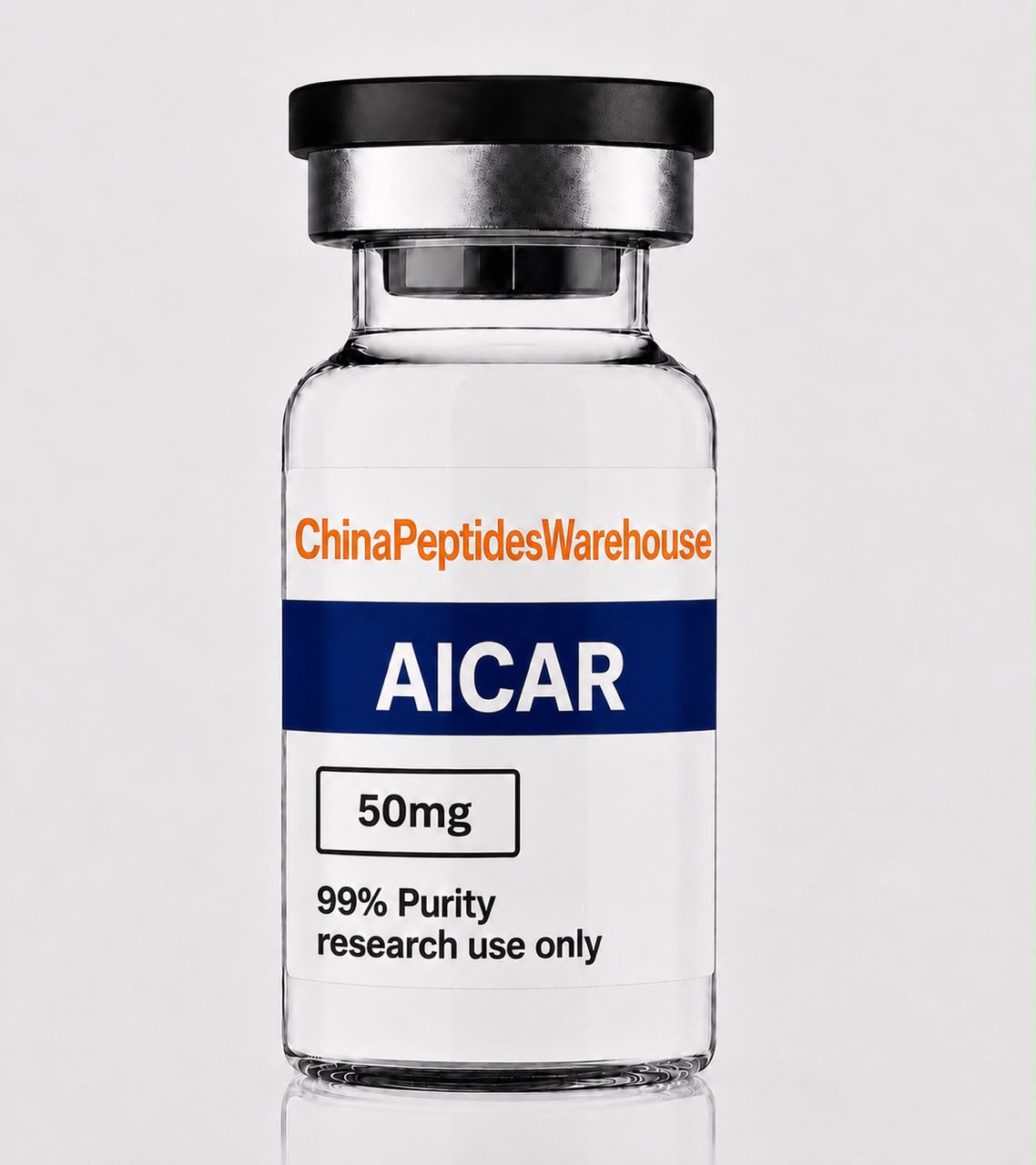
BUY AICAR 50mg
$72.00
AICAR (chemically known as Acadesine, 5-Aminoimidazole-4-carboxamide ribonucleotide, or AICA-riboside) is a synthetic analog of adenosine monophosphate (AMP) engineered to directly target and activate cellular metabolic machinery. Recognized in metabolic, cardiovascular, and exercise physiology research, AICAR functions as a potent agonist of AMP-activated protein kinase (AMPK)—the master regulatory enzyme responsible for maintaining cellular energy homeostasis
(Acadesine) AMPK Activator & Metabolic Modulator Guide
Advanced AMP-Activated Protein Kinase Activation, Mitochondrial Biogenesis, Glucose Uptake, and Cellular Bioenergetics
Product Overview & Core Attributes
AICAR (chemically known as Acadesine, 5-Aminoimidazole-4-carboxamide ribonucleotide, or AICA-riboside) is a synthetic analog of adenosine monophosphate (AMP) engineered to directly target and activate cellular metabolic machinery. Recognized in metabolic, cardiovascular, and exercise physiology research, AICAR functions as a potent agonist of AMP-activated protein kinase (AMPK)—the master regulatory enzyme responsible for maintaining cellular energy homeostasis.
At the molecular level, AICAR enters cells via nucleoside transporters, where it undergoes phosphorylation by adenosine kinase to form its active intracellular metabolite, ZMP (5-aminoimidazole-4-carboxamide ribonucleotide monophosphate). ZMP closely mimics native adenosine monophosphate (AMP) by binding to the regulatory $\gamma$-subunit of AMPK. This binding induces an allosteric conformational change that promotes phosphorylation at the key $Thr^{172}$ residue on the $\alpha$-subunit by upstream kinases such as LKB1.
Unlike standard metabolic agents that rely on nutrient depletion or physical exertion to trigger metabolic shifts, AICAR directly stimulates AMPK independent of the cellular ADP/ATP ratio. This direct activation triggers downstream signal transduction cascades that upregulate glucose transporter 4 (GLUT4) translocation, stimulate fatty acid oxidation, promote mitochondrial biogenesis via PGC-1$\alpha$ activation, and inhibit rate-limiting anabolic pathways such as lipid and protein synthesis under energy-stressed conditions.
                               +------------------------------------------+
                               |                  AICAR                   |
                               |          (AICA-Riboside / ZMP)           |
                               +--------------------+---------------------+
                                                    |
                                                    v
                               +------------------------------------------+
                               |     Intracellular Phosphorylation via    |
                               |            Adenosine Kinase              |
                               +--------------------+---------------------+
                                                    |
                                                    v
                               +------------------------------------------+
                               |    Formed ZMP Binds γ-Subunit of AMPK    |
                               |    (Induces Thr172 Phosphorylation)      |
                               +--------------------+---------------------+
                                                    |
           +----------------------------------------+----------------------------------------+
           |                                                                                 |
           v                                                                                 v
+------------------------------------+                                            +------------------------------------+
|     Metabolic Bioenergetics        |                                            |      Cellular Autophagy &          |
|    Upregulation & Biogenesis       |                                            |     Protective Pathways            |
+------------------+-----------------+                                            +------------------+-----------------+
                   |                                                                                 |
                   v                                                                                 v
  Stimulates GLUT4 Translocation,                                                  Suppresses Inflammatory Cytokines,
  Fatty Acid Oxidation & PGC-1α                                                    Inhibits Anabolic mTOR Pathways
                   |                                                                                 |
                   +------------------------------------+--------------------------------------------+
                                                        |
                                                        v
                                       +----------------------------------+
                                       | Enhanced Cellular Endurance,     |
                                       | Glucose Homeostasis & Repair     |
                                       +----------------------------------+
Key Technical Features:
-
Direct AMPK Activation: Binds the regulatory $\gamma$-subunit of AMPK via its active metabolite ZMP, triggering downstream metabolic signaling without requiring cellular ATP depletion.
-
GLUT4 Translocation Enhancement: Drives insulin-independent glucose uptake into skeletal muscle cells, supporting blood glucose regulation and metabolic flexibility.
-
Mitochondrial Biogenesis Acceleration: Upregulates PGC-1$\alpha$ (peroxisome proliferator-activated receptor gamma coactivator 1-alpha) expression, promoting new mitochondrial density and aerobic capacity.
-
Fatty Acid Oxidation Activation: Phosphorylates and inactivates Acetyl-CoA Carboxylase (ACC), reducing malonyl-CoA production and increasing fatty acid transport into mitochondria for oxidation.
-
Cellular Stress & Autophagy Regulation: Modulates inflammation by suppressing nuclear factor kappa B (NF-$\kappa$B) signaling and promoting autophagic cleanup of damaged cellular components.
Technical & Chemical Specifications
Review the chemical, analytical, and physical properties defining research-grade AICAR:
| Feature / Parameter | Analytical Specification |
| Chemical Name | 5-Aminoimidazole-4-carboxamide 1-$\beta$-D-ribofuranoside, Acadesine |
| CAS Registry Number | 2627-69-2 |
| Synonyms | AICA Riboside, Acadra, ZMP Precursor |
| Molecular Formula | $\text{C}_9\text{H}_{14}\text{N}_4\text{O}_5$ |
| Molecular Weight | 258.23 g/mol |
| Structural Class | Imidazole nucleoside derivative |
| Purity Standard | $\ge 98.0\%$ (determined via RP-HPLC and MS analysis) |
| Physical Appearance | Sterile, lyophilized white to off-white crystalline powder |
| Solubility Profile | Water ($\ge 25\text{ mg/mL}$), DMSO ($\ge 50\text{ mg/mL}$), PBS ($\text{pH } 7.2$) |
| Mechanism of Action | Allosteric AMPK activator via intracellular conversion to ZMP |
| Storage Temperature | Freeze-stored at $-20^\circ\text{C}$ to $-80^\circ\text{C}$ in desiccated conditions |
Reconstitution & Handling Protocol
To preserve structural stability and maintain solubility, standard laboratory guidelines must be observed during reconstitution and handling.
+-------------------------------------------------------------------------+
|                  LABORATORY RECONSTITUTION STEPS                        |
+-------------------------------------------------------------------------+
| Step 1: Equilibrium   --> Allow vial to reach room temp (15-20 min)     |
| Step 2: Sterilization --> Clean rubber septum with 70% IPA swab         |
| Step 3: Diluent Intro --> Slow injection of Sterile Water or PBS        |
| Step 4: Solubilization--> Gentle circular swirling (DO NOT SHAKE)       |
| Step 5: Cold Storage  --> Store liquid at 2°C to 8°C (Refrigerated)     |
+-------------------------------------------------------------------------+
Equipment & Reagents:
-
Lyophilized Vial: Standard 10 mg, 50 mg, or 100 mg sterile glass vial.
-
Reagent Diluent: Sterile Water for Injection, Bacteriostatic Water (0.9% Benzyl Alcohol), or Phosphate-Buffered Saline (PBS, $\text{pH } 7.4$).
-
Equipment: Sterile 1 mL to 5 mL syringes with 21G–27G needles.
-
Disinfectant: Medical-grade 70% Isopropyl Alcohol (IPA) wipes.
Step-by-Step Reconstitution Protocol:
-
Temperature Balancing: Allow the frozen vial to reach room temperature for 15 to 20 minutes before handling to prevent condensation inside the container.
-
Septum Disinfection: Remove the flip-off cap. Thoroughly wipe the rubber stopper using a fresh 70% IPA swab and allow it to air-dry completely.
-
Diluent Injection: Draw up the measured diluent volume (e.g., 2.0 mL of sterile water for a 50 mg vial to achieve a 25 mg/mL concentration). Insert the needle through the center of the septum at a 45-degree angle.
-
Controlled Wall Flow: Slowly depress the syringe plunger, directing the fluid stream against the inner glass wall. Avoid spraying liquid directly onto the lyophilized powder cake.
-
Solubilization: Allow the diluent to fully saturate the powder. Gently swirl the vial in a smooth circular motion. Do not shake the vial vigorously, as mechanical agitation can introduce air bubbles and disrupt molecular stability.
-
Visual Inspection: Verify that the reconstituted liquid is clear, colorless, and free of undissolved particulate matter before use.
Storage Requirements & Temperature Stability
Adhering to correct storage temperatures protects AICAR from chemical hydrolysis and degradation over time:
+--------------------------------------------------------------------+
|                  TEMPERATURE STABILITY MATRIX                      |
+--------------------------------------------------------------------+
|  Dry Powder (-20°C to -80°C)  | Stable for up to 36 Months         |
|  Dry Powder (Room Temp / 20°C)| Stable for 2-4 Weeks (Transit)     |
|  Reconstituted Liquid (2°-8°C)| Stable for up to 4-6 Weeks         |
|  Reconstituted Liquid (>25°C) | Degrades Rapidly (Avoid Exposure)  |
+--------------------------------------------------------------------+
-
Lyophilized Powder: Store unhydrated, sealed vials in a freezer at $-20^\circ\text{C}$ to $-80^\circ\text{C}$. Under these conditions, the powder remains stable for up to 36 months.
-
Reconstituted Solution: Once dissolved in bacteriostatic water or PBS, store liquid vials under refrigeration at $2^\circ\text{C}$ to $8^\circ\text{C}$. Use within 30 to 45 days to maintain potency.
-
Freezing Reconstituted Aliquots: For long-term storage of liquid stock solutions, divide into single-use aliquots and store at $-80^\circ\text{C}$. Avoid repeated freeze-thaw cycles.
-
Light Protection: Keep vials inside opaque secondary packaging away from direct light and UV exposure.
Sourcing Standards & Procurement Guidance
When evaluating options to buy AICAR or selecting high-purity research materials online, verifying analytical testing documentation ensures batch quality and experimental repeatability.
+--------------------------------------------------------------------+
|                 CHEMICAL SOURCING QUALITY CHECKLIST                |
+--------------------------------------------------------------------+
|  [x] High-Performance Liquid Chromatography (HPLC) Purity >= 98%   |
|  [x] Mass Spectrometry (MS) Identity Verification (258.23 g/mol)    |
|  [x] Low Endotoxin & Heavy Metal Analysis (< 0.05 EU/mg)           |
|  [x] Vacuum-Sealed Borosilicate Glass Vials with Intact Seals      |
|  [!] AVOID: Suppliers lacking lot-specific analytical COA reports  |
+--------------------------------------------------------------------+
1. Analytical Certificate of Analysis (COA) Verification
Always request a lot-specific COA from an accredited testing laboratory. A complete analytical certificate must document:
-
RP-HPLC Analysis: Confirms that the target peak area represents $\ge 98.0\%$ purity, ensuring freedom from synthesis side-products or unreacted precursors.
-
Mass Spectrometry (ESI-MS): Confirms that the molecular mass matches the theoretical 258.23 g/mol value.
-
Endotoxin & Heavy Metal Testing: Validates that endotoxin levels remain below $<0.05\text{ EU/mg}$ and heavy metals are absent.
2. Evaluating Vendor Quality
Researchers searching to AICAR buy stock online should prioritize verified suppliers offering batch traceability, proper packaging, and third-party lab documentation. High-purity AICAR for sale online is typically distributed in sealed borosilicate glass vials to prevent moisture ingress. If you are reviewing vendors to buy AICAR supplies for laboratory use, ensure that analytical COA reports are readily available prior to purchase.
Customer & Researcher Reviews
Read documented feedback from research professionals and laboratory specialists evaluating product purity and performance:
“Exceptional AMPK Activation in Muscle Cell Lines”
“We utilized this compound in C2C12 myotube cell assays to analyze insulin-independent glucose transport. The material dissolved completely in PBS without precipitation. HPLC verification confirmed 98.8% purity, and the observed increase in GLUT4 translocation aligned perfectly with literature benchmarks.”
— Dr. Aris V., Senior Metabolic Biochemist
“Consistent High-Purity Material for Biogenesis Studies”
“Our research group studies mitochondrial biogenesis and PGC-1$\alpha$ signaling pathways. Ordering this lot was seamless, and the vendor supplied full mass spectrometry documentation. Product stability across multiple trial sets remained rock-solid.”
— Elena M., Cellular Physiology Lead
“Rapid Solubilization and High Quality Control”
“Having a reliable source for high-purity metabolic research reagents is critical for our lab. The powder reconstituted effortlessly in sterile water, producing a clear, particle-free solution. The lot-specific COA matched our internal analytical validation.”
— Marcus L., Laboratory Operations Director
Frequently Asked Questions (FAQ)
Q1: How does AICAR differ from direct metabolic inhibitors like Metformin?
While both compounds activate AMPK pathways, Metformin acts indirectly by inhibiting Complex I of the mitochondrial electron transport chain (raising the AMP/ATP ratio). AICAR is converted intracellularly to ZMP, which directly mimics AMP and binds the $\gamma$-subunit of AMPK, activating the enzyme without disrupting mitochondrial ATP production.
Q2: What is the primary role of ZMP in AICAR signaling?
Inside the cell, AICAR is phosphorylated by adenosine kinase into ZMP (5-aminoimidazole-4-carboxamide ribonucleotide monophosphate). ZMP acts as an AMP analog, binding to AMPK’s regulatory subunit to induce conformational changes that trigger phosphorylation and activation.
Q3: What diluent is recommended for reconstituting AICAR?
For long-term stored stock solutions, sterile Bacteriostatic Water or Phosphate-Buffered Saline (PBS, $\text{pH } 7.4$) is recommended. For immediate single-use cell culture assays, sterile Water for Injection or unsupplemented culture media may be used.
Q4: What is the aqueous solubility limit of AICAR?
AICAR demonstrates high water solubility, dissolving up to $\ge 25\text{ mg/mL}$ in sterile water or PBS, and up to $\ge 50\text{ mg/mL}$ in dimethyl sulfoxide (DMSO).
Q5: How does AICAR promote mitochondrial biogenesis?
By activating AMPK, AICAR triggers the phosphorylation of PGC-1$\alpha$ (peroxisome proliferator-activated receptor gamma coactivator 1-alpha). Activated PGC-1$\alpha$ acts as a master transcriptional coactivator that upregulates nuclear and mitochondrial genes responsible for synthesizing new mitochondria.
Q6: What physical signs indicate compound degradation?
Physical indicators of degradation include incomplete dissolution, persistent cloudiness, or discoloration after mixing. If the reconstituted liquid fails to clear after gentle circular swirling, discard the vial.
Q7: What analytical methods are used to verify AICAR purity?
Purity is measured using Reverse-Phase High-Performance Liquid Chromatography (RP-HPLC), while exact molecular weight and chemical identity are verified via Electrospray Ionization Mass Spectrometry (ESI-MS).
Summary & Key Takeaways
AICAR (Acadesine) remains a cornerstone tool in metabolic and cellular bioenergetics research. By undergoing intracellular conversion to ZMP and directly activating AMPK pathways, this nucleotide analog drives glucose uptake, accelerates fatty acid oxidation, and stimulates mitochondrial biogenesis.
When sourcing AICAR for laboratory research, select verified vendors offering lot-specific COA reports, high HPLC purity ratings ($\ge 98.0\%$), and reliable cold-chain packaging to ensure consistent experimental outcomes.
Reviews
There are no reviews yet.