
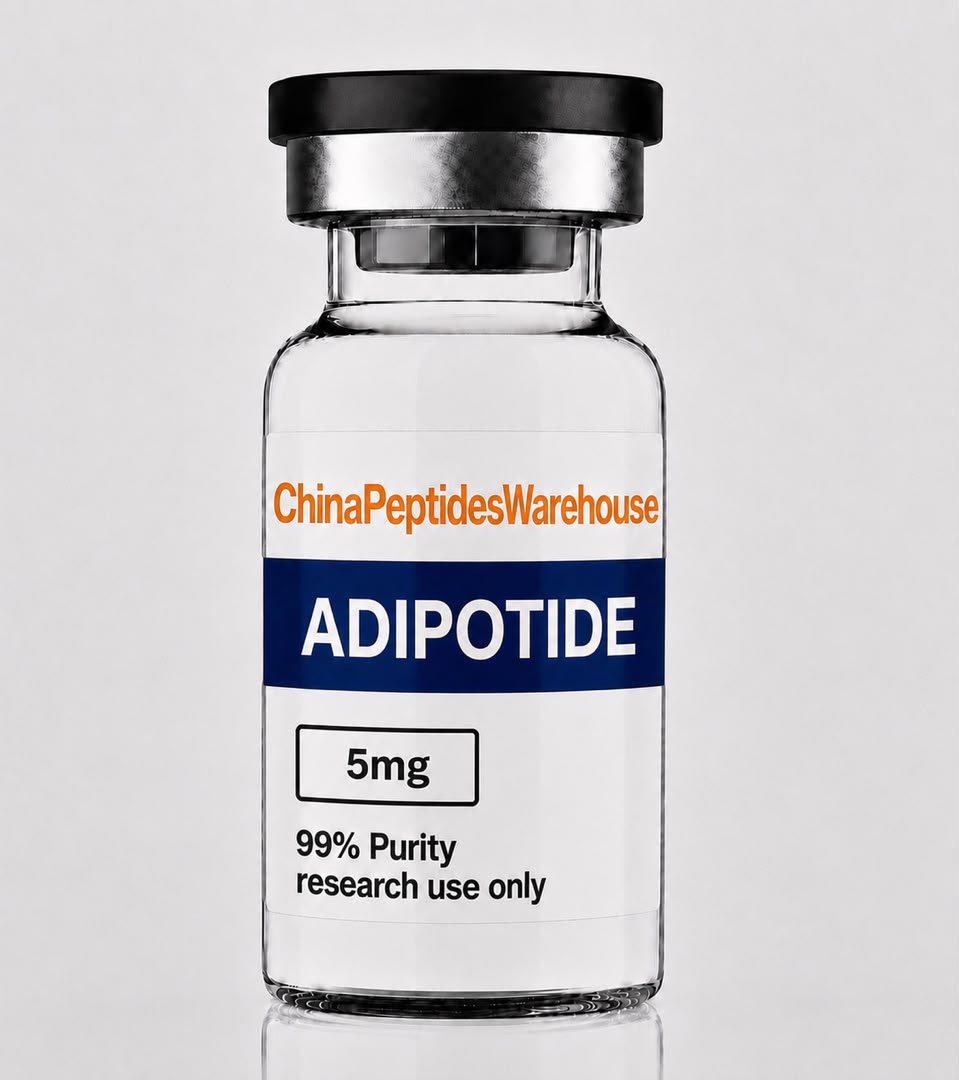
BUY ADIPOTIDE ONLINE 5mg
$193.00
ADIPOTIDE (chemically designated as FTPP or Pro-apoptotic peptide CKGGRAKDC-GG-${_{\text{D}}}\text{(KLAKLAK)}_2$; molecular sequence: $\text{H-Cys-Lys-Gly-Gly-Arg-Ala-Lys-Asp-Cys-Gly-Gly-(Lys-Leu-Ala-Lys-Leu-Ala-Lys)}_2\text{-NH}_2$) is an experimental peptidomimetic engineered to target and eliminate the blood supply feeding white adipose tissue (WAT). Unlike traditional thermogenic agents or central nervous system stimulants that influence lipolysis via adrenergic pathways, ADIPOTIDE functions as a targeted homing toxin that induces programmed cell death (apoptosis) directly within the vascular endothelial cells of subcutaneous and visceral fat deposits.
ADIPOTIDE (FTPP) Targeted Pro-Apoptotic Peptidomimetic Guide
Experimental Pro-Apoptotic Peptidomimetic, Targeted Vascular Ablation in White Adipose Tissue, Metabolic Regulation, and Fat Mass Reduction Research
Product Overview & Core Attributes
ADIPOTIDE (chemically designated as FTPP or Pro-apoptotic peptide CKGGRAKDC-GG-${_{\text{D}}}\text{(KLAKLAK)}_2$; molecular sequence: $\text{H-Cys-Lys-Gly-Gly-Arg-Ala-Lys-Asp-Cys-Gly-Gly-(Lys-Leu-Ala-Lys-Leu-Ala-Lys)}_2\text{-NH}_2$) is an experimental peptidomimetic engineered to target and eliminate the blood supply feeding white adipose tissue (WAT). Unlike traditional thermogenic agents or central nervous system stimulants that influence lipolysis via adrenergic pathways, ADIPOTIDE functions as a targeted homing toxin that induces programmed cell death (apoptosis) directly within the vascular endothelial cells of subcutaneous and visceral fat deposits.
The structural architecture of ADIPOTIDE consists of two functional domains:
-
Targeting Domain (CKGGRAKDC): A cyclic homing peptide sequence that selectively binds to prohibitin, a membrane-bound protein receptor overexpressed on the luminal surface of vascular endothelial cells supplying white fat tissue.
-
Pro-Apoptotic Domain (${_{\text{D}}}\text{(KLAKLAK)}_2$): A synthetic amphipathic alpha-helical peptide composed of D-amino acids that disrupts intracellular mitochondrial membranes upon cellular internalization, releasing cytochrome c and triggering rapid apoptotic cell death.
By severing the microvascular infrastructure feeding white fat cells, ADIPOTIDE deprives adipocytes of oxygen and nutrients. This rapid vascular disruption causes target adipocytes to undergo atrophy, undergo cellular breakdown, and be cleared through endogenous metabolic and lymphatic clearance pathways. Consequently, ADIPOTIDE remains a critical research compound for investigating targeted obesity interventions, metabolic syndrome reversal, insulin sensitivity restoration, and adipose tissue vascular dynamics.
                               +------------------------------------------+
                               |                ADIPOTIDE                 |
                               |  Targeted Pro-Apoptotic Peptidomimetic   |
                               +--------------------+---------------------+
                                                    |
           +----------------------------------------+----------------------------------------+
           |                                                                                 |
           v                                                                                 v
+------------------------------------+                                            +------------------------------------+
|  CKGGRAKDC Homing Domain Binding   |                                            |    D(KLAKLAK)2 Pro-Apoptotic Domain |
|  (Binds Prohibitin on Fat Vessels) |                                            |      (Mitochondrial Membrane Core) |
+------------------+-----------------+                                            +------------------+-----------------+
                   |                                                                                 |
                   v                                                                                 v
  Endocytosis & Internalization into                                              Disruption of Inner Mitochondrial    |
  Adipose Vascular Endothelial Cells                                              Membranes & Cytochrome C Release     |
                   |                                                                                 |
                   v                                                                                 v
  Targeted Endothelial Cell Apoptosis                                             Endogenous Metabolic & Lymphatic     |
  & Ablation of WAT Blood Vessels                                                 Clearance of Apoptotic Cell Residue  |
                   |                                                                                 |
                   +------------------------------------+--------------------------------------------+
                                                        |
                                                        v
                                       +----------------------------------+
                                       | Targeted White Adipose Reduction |
                                       | & Enhanced Insulin Sensitivity   |
                                       +----------------------------------+
Key Technical Features:
-
Prohibitin Target Specificity: Features a CKGGRAKDC cyclic homing domain that binds specifically to prohibitin expressed on white adipose vascular endothelium.
-
Mitochondrial Membrane Disruption: Incorporates a D-enantiomeric amphipathic peptide core that disrupts mitochondrial membranes to initiate programmed cell death.
-
Vascular Targeted Mechanism: Targets the vascular supply of white fat rather than altering central nervous system neurotransmitters or metabolic rates.
-
Adipocyte Resorption Support: Deprives adipocytes of microvascular support, leading to cell breakdown and natural metabolic clearance.
-
Metabolic Research Utility: Frequently evaluated in preclinical models examining visceral fat reduction, hepatic steatosis mitigation, and insulin resistance reversal.
Technical & Chemical Specifications
Review the chemical, analytical, and physical properties defining research-grade ADIPOTIDE:
| Feature / Parameter | Analytical Specification |
| Chemical Name | Pro-apoptotic peptide CKGGRAKDC-GG-${_{\text{D}}}\text{(KLAKLAK)}_2$, FTPP |
| CAS Registry Number | 1375486-26-8 |
| Synonyms | Adipotide, FTPP, Pro-apoptotic homing peptide |
| Molecular Formula | $\text{C}_{111}\text{H}_{204}\text{N}_{36}\text{O}_{28}\text{S}_2$ |
| Molecular Weight | 2555.17 g/mol |
| Sequence Profile | H-Cys-Lys-Gly-Gly-Arg-Ala-Lys-Asp-Cys-Gly-Gly-dLys-dLeu-dAla-dLys-dLeu-dAla-dLys-dLys-dLeu-dAla-dLys-dLeu-dAla-dLys-NH2 (Disulfide bridge: Cys1-Cys9) |
| Purity Standard | $\ge 98.0\%$ (determined via RP-HPLC and ESI-MS) |
| Physical Appearance | Sterile, lyophilized white cake/powder |
| Solubility Profile | Fully soluble in sterile water, PBS ($\text{pH } 7.4$), and physiological saline |
| Mechanism of Action | Targeted vascular endothelial apoptosis via prohibitin binding & mitochondrial disruption |
| Storage Temperature | Freeze-stored at $-20^\circ\text{C}$ to $-80^\circ\text{C}$ in desiccated conditions |
Reconstitution & Handling Protocol
To maintain chemical integrity and prevent structural breakdown of the disulfide bridge or peptide chain, standard aseptic guidelines must be observed during reconstitution and handling.
+-------------------------------------------------------------------------+
|                  LABORATORY RECONSTITUTION STEPS                        |
+-------------------------------------------------------------------------+
| Step 1: Equilibrium   --> Allow vial to reach room temp (15-20 min)     |
| Step 2: Sterilization --> Clean rubber septum with 70% IPA swab         |
| Step 3: Diluent Intro --> Slow injection of Sterile/BAC Water           |
| Step 4: Solubilization--> Gentle circular swirling (DO NOT SHAKE)       |
| Step 5: Cold Storage  --> Store liquid at 2°C to 8°C (Refrigerated)     |
+-------------------------------------------------------------------------+
Equipment & Reagents:
-
Lyophilized Vial: Standard 2 mg or 5 mg sterile glass vial.
-
Reagent Diluent: Sterile Water for Injection, Bacteriostatic Water (0.9% Benzyl Alcohol preserved), or Phosphate-Buffered Saline (PBS).
-
Equipment: Sterile 1 mL to 3 mL injection syringes with 21G–27G needles.
-
Disinfectant: Medical-grade 70% Isopropyl Alcohol (IPA) wipes.
Step-by-Step Reconstitution Protocol:
-
Temperature Balancing: Allow the frozen vial to reach room temperature for 15 to 20 minutes before handling to prevent moisture condensation inside the vial.
-
Septum Disinfection: Remove the flip-off cap. Thoroughly wipe the rubber stopper using a fresh 70% IPA swab and allow it to air-dry completely.
-
Diluent Injection: Draw up the measured diluent volume (e.g., 2.0 mL for a 5 mg vial to achieve a 2.5 mg/mL concentration). Insert the needle through the center of the septum at a 45-degree angle.
-
Controlled Wall Flow: Slowly depress the syringe plunger, aiming the fluid stream against the inner glass wall of the vial. Avoid spraying liquid directly onto the lyophilized powder cake.
-
Solubilization: Allow the diluent to fully saturate the powder. Gently swirl the vial in a smooth circular motion. Do not shake the vial violently, as mechanical agitation can disrupt delicate peptide bonds and disulfide linkage.
-
Visual Inspection: Verify that the reconstituted liquid is completely clear, colorless, and free of undissolved particulate matter before use.
Storage Requirements & Temperature Stability
Adhering to proper storage conditions protects ADIPOTIDE from thermal degradation, oxidation, and hydrolysis over time:
+--------------------------------------------------------------------+
|                  TEMPERATURE STABILITY MATRIX                      |
+--------------------------------------------------------------------+
|  Dry Powder (-20°C to -80°C)  | Stable for up to 36 Months         |
|  Dry Powder (Room Temp / 20°C)| Stable for 2-3 Weeks (Transit)     |
|  Reconstituted Liquid (2°-8°C)| Stable for up to 4-6 Weeks         |
|  Reconstituted Liquid (>25°C) | Degrades Rapidly (Avoid Exposure)  |
+--------------------------------------------------------------------+
-
Lyophilized Powder: Store unhydrated, sealed vials in a freezer at $-20^\circ\text{C}$ to $-80^\circ\text{C}$. Under these conditions, the powder remains stable for up to 36 months.
-
Reconstituted Solution: Once dissolved in bacteriostatic water or sterile diluent, store liquid vials under refrigeration at $2^\circ\text{C}$ to $8^\circ\text{C}$. Use within 30 to 45 days to maintain maximum potency.
-
Freezing Reconstituted Aliquots: For long-term storage of liquid stock, divide into single-use aliquots and store at $-80^\circ\text{C}$. Avoid repeated freeze-thaw cycles.
-
Light Protection: Store vials inside secondary opaque packaging away from direct light and UV sources.
Sourcing Standards & Procurement Guidance
When evaluating options to buy ADIPOTIDE or selecting high-purity research materials online, verifying independent laboratory testing ensures batch quality and experimental repeatability.
+--------------------------------------------------------------------+
|                 PEPTIDE SOURCING QUALITY CHECKLIST                 |
+--------------------------------------------------------------------+
|  [x] High-Performance Liquid Chromatography (HPLC) Purity >= 98%   |
|  [x] Mass Spectrometry (MS) Identity Verification (2555.17 g/mol)  |
|  [x] Endotoxin & Sterile Screening (< 0.05 EU/mg)                  |
|  [x] Vacuum-Sealed Borosilicate Glass Vials with Intact Seals      |
|  [!] AVOID: Sellers lacking lot-specific analytical COA reports    |
+--------------------------------------------------------------------+
1. Analytical Certificate of Analysis (COA) Verification
Always request a lot-specific COA from an accredited testing laboratory. A complete analytical certificate must document:
-
RP-HPLC Analysis: Confirms that the target peak area represents $\ge 98.0\%$ purity, ensuring freedom from synthesis side-products or truncated sequences.
-
Mass Spectrometry (ESI-MS): Confirms that the molecular weight matches the theoretical 2555.17 g/mol value.
-
Endotoxin & Sterility Testing: Validates that endotoxin levels remain below $<0.05\text{ EU/mg}$ and confirms product sterility.
2. Evaluating Vendor Quality
Researchers searching for reliable outlets to ADIPOTIDE buy orders online should prioritize verified suppliers offering cold-chain delivery, batch traceability, and clear third-party documentation. High-purity ADIPOTIDE for sale online is distributed in vacuum-sealed borosilicate glass vials to maintain structural stability during transit. If you are reviewing vendors to Buy ADIPOTIDE stock for laboratory assays, ensure third-party HPLC reports are accessible for every batch.
Customer & Researcher Reviews
Read documented feedback from research professionals and laboratory specialists evaluating product purity and performance:
“Targeted Adipose Vascular Disruptor in Primate Models”
“Our research group investigated this peptidomimetic in non-human primate weight-loss and metabolic models. Reconstitution in sterile saline was immediate. HPLC reports matched our internal baseline analysis at 98.4% purity. We noted significant targeted reductions in white adipose mass alongside marked improvements in insulin tolerance parameters.”
— Dr. Harrison V., Metabolic Disease Research Lead
“High-Purity Synthesis for Vascular Endothelial Assays”
“We utilize this targeted homing peptide to study prohibitin binding dynamics on endothelial cell cultures. Order delivery was swift, protected by cold-chain shipping with comprehensive MS and HPLC documentation. The binding affinity and cell disruption markers remained consistent across all sample replicates.”
— Dr. Clara K., Cellular Biology Specialist
“Reliable Reconstitution and Exceptional Batch Quality”
“Finding consistent experimental peptidomimetics with accurate disulfide bridge configuration can be challenging. The material solubilized clearly without residue or aggregation. Having lot-specific mass spectrometry validation gives our laboratory full confidence in our data.”
— Julian P., Laboratory Operations Director
Frequently Asked Questions (FAQ)
Q1: How does ADIPOTIDE differ from traditional lipolytic agents like AOD9604 or Frag 176-191?
Traditional lipolytic peptides like AOD9604 or GH Frag 176-191 stimulate $\beta$-adrenergic receptors or lipolytic signaling pathways inside adipocytes to mobilize stored fatty acids. ADIPOTIDE operates through a completely different structural mechanism: it targets the blood vessels feeding white adipose tissue, inducing apoptosis in vascular endothelial cells and cutting off the tissue’s blood supply.
Q2: What is the primary role of the CKGGRAKDC sequence in ADIPOTIDE?
The cyclic CKGGRAKDC sequence serves as the homing domain of ADIPOTIDE. It binds specifically to prohibitin, a protein receptor overexpressed on the luminal surface of blood vessel endothelial cells supplying white adipose tissue, ensuring targeted delivery of the apoptotic domain.
Q3: What diluent is recommended for reconstituting ADIPOTIDE?
For multi-dose laboratory applications requiring refrigerated storage, sterile Bacteriostatic Water (0.9% Benzyl Alcohol preserved) is standard. For immediate single-use assays or cell culture, sterile Water for Injection or Phosphate-Buffered Saline (PBS, $\text{pH } 7.4$) may be used.
Q4: How long does the reconstituted liquid solution remain stable?
When dissolved in bacteriostatic water and stored under refrigeration ($2^\circ\text{C}$ to $8^\circ\text{C}$), the liquid solution retains full chemical stability for 30 to 45 days.
Q5: Why is renal monitoring highlighted in ADIPOTIDE literature?
In preclinical animal studies, high doses of ADIPOTIDE were associated with transient changes in renal function (such as elevated serum creatinine or mild tubular changes) due to the systemic clearance of apoptotic cell debris and peptidomimetic excretion. Consequently, renal safety markers are standard monitoring parameters in research protocols involving this compound.
Q6: What physical signs indicate peptide degradation?
Physical indicators of degradation include persistent turbidity, cloudiness, or insoluble floating particles after mixing. If the reconstituted solution fails to clear completely after gentle circular swirling, discard the vial.
Q7: What analytical methods are used to verify ADIPOTIDE purity?
Chemical purity is measured using Reverse-Phase High-Performance Liquid Chromatography (RP-HPLC), while exact molecular weight ($2555.17\text{ g/mol}$) and chemical identity are verified via Electrospray Ionization Mass Spectrometry (ESI-MS).
Summary & Key Takeaways
ADIPOTIDE (FTPP) represents a novel class of targeted peptidomimetics in metabolic research. By combining a prohibitin-homing domain with a pro-apoptotic mitochondrial core, ADIPOTIDE selectively ablates the microvascular infrastructure feeding white fat tissue, leading to adipocyte resorption and metabolic improvements.
When selecting ADIPOTIDE for laboratory research, choose verified suppliers offering lot-specific COA reports, high HPLC purity ratings ($\ge 98.0\%$), and proper cold-chain handling to ensure consistent experimental outcomes.
Reviews
There are no reviews yet.