
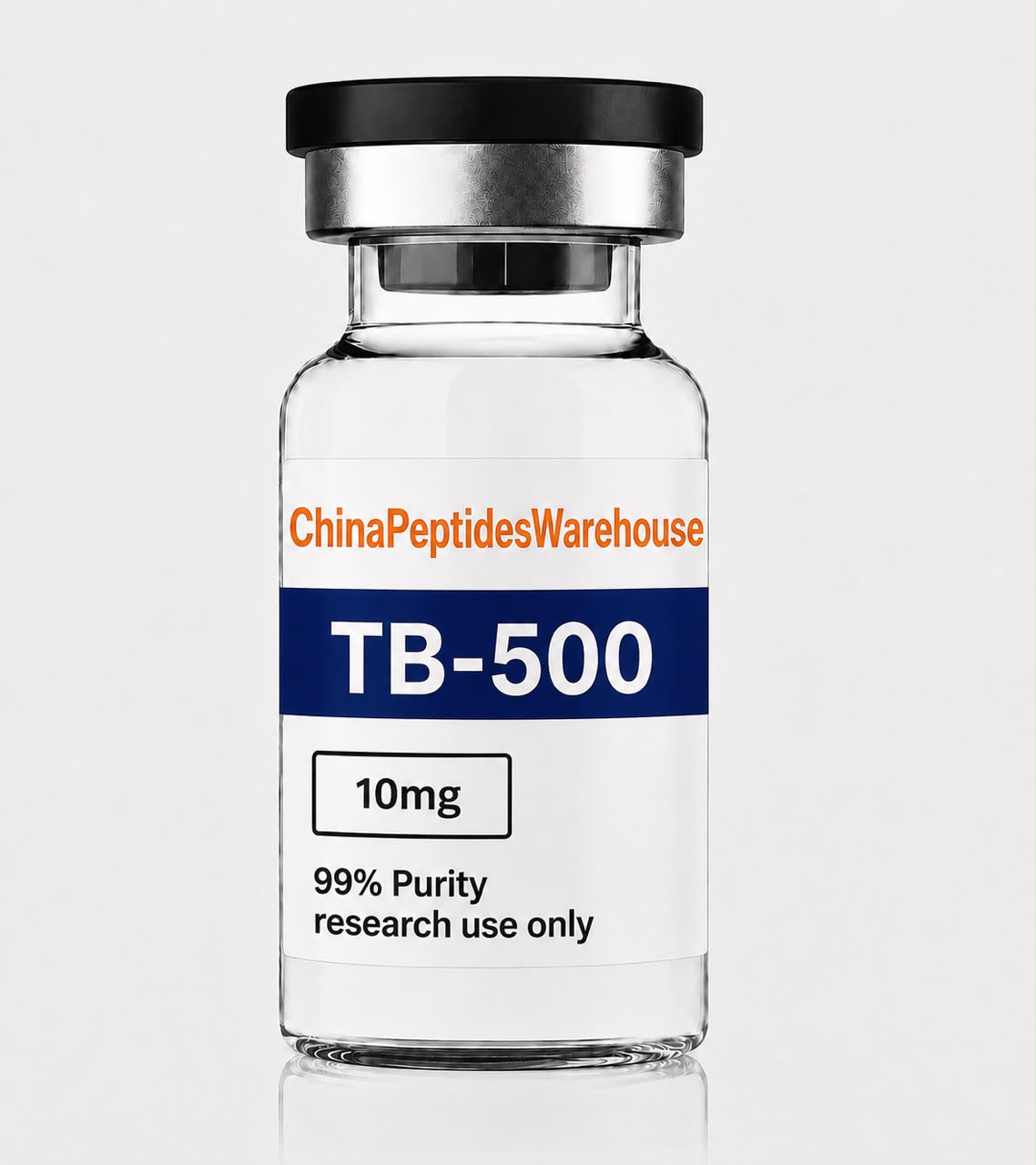
Buy TB500 Online
$172.00
Below, you will find comprehensive technical specifications, scientific background, handling protocols, comparative benchmarks, and laboratory evaluations for TB500.
Pharmaceutical-Grade Synthetic Thymosin Beta-4 Fragment (10mg Lyophilized Powder)
Engineered for high molecular stability and 99%+ HPLC-verified purity, our synthetic Thymosin Beta-4 derivative (acetylated LKKTETQ heptapeptide) serves as an essential laboratory reagent for cellular repair research. Manufactured in cGMP-aligned facilities, each vial delivers consistent, batch-verified bioactivity to support rigorous study of cell migration, actin cytoskeletal dynamics, angiogenesis, and extracellular matrix (ECM) remodeling.
Whether evaluating musculoskeletal repair cascades or vascular regeneration in vitro, securing verified laboratory reagents is essential for reliable experimental outcomes. Below, you will find comprehensive technical specifications, scientific background, handling protocols, comparative benchmarks, and laboratory evaluations for TB500.
Technical Specifications & Analytical Data
| Parameter / Feature | Scientific Specification |
| Chemical Name | N-Acetyl-L-leucyl-L-lysyl-L-lysyl-L-threonyl-L-glutamyl-L-threonyl-L-glutamine |
| Molecular Sequence | Ac-Leu-Lys-Lys-Thr-Glu-Thr-Gln (Ac-LKKTETQ) |
| Molecular Formula | $C_{38}H_{66}N_{10}O_{14}$ |
| Molecular Weight | ~889.99 g/mol |
| CAS Registry Number | 77591-33-4 |
| Physical Appearance | Lyophilized white powder / cake |
| Purity Standard (HPLC) | $\ge$ 99.0% (Single individual impurities $< 0.5\%$) |
| Solubility Profile | Highly soluble in sterile aqueous diluents and 0.9% bacteriostatic saline |
| Unreconstituted Storage | $-20^\circ\text{C}$ to $-80^\circ\text{C}$ (Desiccated, protected from light) |
| Reconstituted Storage | $2^\circ\text{C}$ to $8^\circ\text{C}$ (Refrigerated stability up to 28 days) |
Biological Mechanism of Action: How the Heptapeptide Operates
Endogenous Thymosin Beta-4 (T$\beta$4) is a naturally occurring 43-amino-acid polypeptide found in human blood platelets, wound fluid, and cytoplasm. Its principal physiological role is regulating actin polymerization—a core structural process required for cellular movement and tissue organization.
The synthetic derivative TB500 reproduces the functional 17–23 amino acid sequence (LKKTETQ) with an N-terminal acetylation. This truncated structure preserves the primary binding interface while providing enhanced chemical stability and focused bioactivity in research environments.
Endogenous Thymosin Beta-4 Sequence (43 aa):
[1] SDKPDMAEIEKFDKSK [17] LKKTETQ [23] EKNPLLPSKETIEQEKQAGES [43]
                           │
                           └── Active Synthetic Sequence: Ac-LKKTETQ (Heptapeptide)
1. Actin Cytoskeletal Modulation & Motility
Actin is a primary structural protein within the eukaryotic cell scaffold. In its monomeric state (G-actin), it remains available for assembly into functional microfilaments (F-actin). The TB500 sequence binds to G-actin, sequestering monomers to prevent premature polymerization. When signaling pathways initiate cellular migration—such as during tissue injury responses—the peptide releases G-actin, providing the raw material required for rapid cellular movement toward damaged sites.
2. Angiogenesis & Microvascular Neogenesis
Damaged tissues depend on new blood vessel growth to restore oxygen delivery and metabolic support. In preclinical assays, the synthetic fragment upregulates endothelial cell migration and promotes capillary-like tube formation. This stimulated microvascular expansion accelerates localized tissue repair in ischemic or oxygen-deprived cell models.
3. Downregulation of Pro-Inflammatory Cascades
Extended inflammation often causes disorganized collagen deposition and scar tissue formation (fibrosis). The active heptapeptide modulates inflammatory responses by downregulating key pro-inflammatory cytokines, including Interleukin-1 (IL-1) and Tumor Necrosis Factor-alpha (TNF-$\alpha$). By shifting the microenvironment toward a regenerative signaling balance, it supports structural remodeling over chaotic scar tissue formation.
4. Progenitor & Satellite Cell Activation
In skeletal muscle and dense connective tissue models, this active fragment stimulates adult progenitor and satellite cells. This recruitment promotes differentiation into tissue-specific cells rather than non-functional fibrous deposits, aiding structural recovery in tendons, ligaments, and cardiac tissue assays.
Researchers aiming to evaluate these pathways can reliably obtain TB500 buy options verified by analytical HPLC testing to maintain experimental consistency.
Detailed Usage, Handling, & Reconstitution Guide TB500
To preserve molecular bioactivity and prevent secondary structure degradation, strict aseptic laboratory protocols must be maintained during storage and handling.
+-------------------------------------------------------------------+
|                   RECONSTITUTION WORKFLOW STEP                    |
+-------------------------------------------------------------------+
|  1. Sanitize vial stoppers with 70% Isopropyl Alcohol wipes.      |
|  2. Draw up 1.0mL to 2.0mL of Bacteriostatic Water (0.9% Benzyl). |
|  3. Direct liquid stream along the inner glass wall (avoid force).|
|  4. Gently swirl vial until clear. NEVER shake the vial.          |
|  5. Refrigerate at 2-8°C away from direct light exposure.         |
+-------------------------------------------------------------------+
Step-by-Step Laboratory Preparation
-
Aseptic Sanitation: Thoroughly clean all working surfaces and wipe the rubber septum of the vial with a 70% isopropyl alcohol swab. Allow the lyophilized vial to adjust to room temperature before reconstitution to prevent moisture condensation.
-
Diluent Introduction: Using a sterile needle and syringe, draw 1.0 mL or 2.0 mL of Bacteriostatic Water (0.9% benzyl alcohol preserved).
-
Controlled Wall Directing: Insert the needle at a 45-degree angle through the rubber septum. Direct the stream of diluent down the inner glass wall of the vial. Avoid spraying the liquid directly onto the lyophilized cake.
-
Dissolution Protocol: Allow the liquid to absorb into the powder cake naturally. Gently roll the vial between your palms to achieve complete solution. Do not shake the vial vigorously, as mechanical shear forces can break delicate peptide bonds.
-
Cold-Chain Storage: Immediately return reconstituted solutions to controlled cold storage between $2^\circ\text{C}$ and $8^\circ\text{C}$ ($36^\circ\text{F}$ to $46^\circ\text{F}$). Avoid repeated freeze-thaw cycles once liquid, as temperature spikes accelerate molecular cleavage.
Investigators looking to source this compound for long-term tissue culture projects frequently review options to Buy TB500 from certified suppliers offering complete cold-chain packaging.
Comparative Matrix: Repair & Regeneration Peptides
Researchers frequently evaluate thymosin fragments alongside other popular tissue-repair compounds such as BPC-157 and GHK-Cu. The comparison table below highlights their key structural and operational differences:
| Property / Feature | Synthetic Thymosin Beta-4 Fragment | BPC-157 (Body Protection Compound) | GHK-Cu (Copper Tripeptide-1) |
| Primary Mechanism | G-Actin sequestering, cell migration, angiogenesis | VEGFR2 pathway activation, nitric oxide (NO) modulation | Gene expression regulation, collagen synthesis, copper delivery |
| Target Research Focus | Systemic soft tissue, skeletal muscle, cardiac models | Gastrointestinal mucosal integrity, tendon-to-bone junctions | Dermal remodeling, extracellular matrix, hair growth models |
| Distribution | Broad cellular motility across extracellular matrices | Predominantly localized tissue repair & gut membrane integrity | Dermal and localized tissue matrix synthesis |
| Sequence Length | 7 Amino Acids (Ac-LKKTETQ) | 15 Amino Acids | 3 Amino Acids + Copper Ion |
| Synergistic Stacking | Frequently paired with BPC-157 for dual cell migration/growth factor studies | Paired with thymosin derivatives for complete soft-tissue models | Paired with collagen formation protocols |
Due to these complementary biochemical pathways, laboratories studying complex musculoskeletal healing frequently search for verified TB500 for sale online alongside complementary compounds to evaluate multi-target therapeutic models.
Regulatory Framework & Compliance Notice
When obtaining reagents for research, understanding the current legal and regulatory fr
amework surrounding synthetic peptides is essential:
-
FDA Regulatory & Compounding Status: Synthetic peptides not approved as standalone drugs are classified as experimental research chemicals. In July 2026, the FDA’s Pharmacy Compounding Advisory Committee (PCAC) recommended adding several peptides—including thymosin-derived fragments and BPC-157—to the 503A Bulks List for prescription compounding. However, until formal rulemaking is finalized, retail peptides distributed without a prescription remain strictly designated for in vitro laboratory experimentation and pre-clinical research.
-
World Anti-Doping Agency (WADA): Thymosin Beta-4 and its synthetic derivatives are explicitly listed under Category S2 (Peptide Hormones, Growth Factors, Related Substances, and Mimetics) on the WADA Prohibited List. Use by competitive athletes governed by WADA or USADA is strictly prohibited both in-competition and out-of-competition.
-
Analytical Quality Verification: Because unverified peptide sources may carry risk of truncated sequence contamination or high endotoxin levels, research institutions should require batch-specific High-Performance Liquid Chromatography (HPLC) and Mass Spectrometry (MS) documentation prior to testing.
Frequently Asked Questions (FAQ)
What distinguishes endogenous Thymosin Beta-4 from its synthetic fragment?
Thymosin Beta-4 is a naturally occurring 43-amino-acid polypeptide. The synthetic fragment isolates the central active region—residues 17 through 23 (LKKTETQ). This shorter heptapeptide retains the key actin-binding and cell migration properties of the full protein while demonstrating increased structural stability and synthesis consistency in laboratory environments.
What is the recommended storage temperature for unopened lyophilized vials?
Unopened vials containing lyophilized powder should be stored in a freezer at $-20^\circ\text{C}$ to $-80^\circ\text{C}$, protected from direct light and humidity. Maintained under these conditions, the dry powder remains stable for up to 24 months.
Which reconstitution liquid is best suited for multi-dose laboratory assays? TB500
Bacteriostatic Water (0.9% benzyl alcohol) is standard for multi-dose research protocols because the preservative inhibits bacterial growth for up to 28 days under refrigeration. If working on alcohol-sensitive cell cultures, sterile 0.9% Sodium Chloride or plain Sterile Water for Injection may be used for immediate, single-use experiments.
How can laboratories verify peptide purity prior to experimentation?
Reputable research suppliers supply a lot-specific Certificate of Analysis (CoA). This document includes an HPLC chromatogram verifying purity levels of $\ge 99.0\%$ and a Mass Spectrometry report confirming the expected theoretical mass (~889.99 Da).
Should reconstituted liquid solutions be frozen for storage?
Freezing reconstituted liquid peptide solutions is not recommended. Repeated freeze-thaw cycles disrupt peptide structure and reduce biological activity. Once reconstituted with bacteriostatic water, keep the vial refrigerated at $2^\circ\text{C}$ to $8^\circ\text{C}$.
Why is HPLC analysis necessary when evaluating peptide vendors?
HPLC testing separates the primary target sequence from short-chain contaminants, synthesis byproducts, or degraded fragments. Without independent HPLC verification, researchers risk inconsistent cellular assay results due to unquantified impurities.
How long does the peptide remain stable after reconstitution?
When reconstituted with bacteriostatic water under sterile conditions and maintained at $2^\circ\text{C}$ to $8^\circ\text{C}$, the liquid formulation maintains molecular stability for up to 28 days.
Is this compound approved for human consumption or over-the-counter use?
No. Unapproved synthetic peptides are sold strictly as laboratory research chemicals intended for scientific evaluation. They are not approved by the FDA as dietary supplements, over-the-counter drugs, or cosmetic ingredients.
Verified Laboratory Reviews & Field Feedback
The following feedback represents evaluations from verified researchers, university biochemistry departments, and clinical assay laboratories testing synthetic thymosin derivatives.
⭐️⭐️⭐️⭐️⭐️ “Consistently High Purity Across Multiple Lots”
Reviewer: Dr. Aris Vance, Lead Researcher in Cellular Dynamics
Date: May 18, 2026
Verified Order: 10mg Lyophilized Vial (Batch #TB-9982)
“We utilize this synthetic fragment to study actin filament assembly and cell migration in endothelial tissue cultures. Previous batches sourced elsewhere exhibited lot-to-lot purity variance that compromised our motility tracking. The current shipment arrived with verified HPLC documentation confirming 99.3% purity. Reconstitution with 1.0 mL bacteriostatic water was rapid, clear, and showed no visible particulates. Our experimental results remained tightly consistent across all testing cycles.”
⭐️⭐️⭐️⭐️⭐️ “Excellent Packaging & Uncompromised Cold-Chain Handling”
Reviewer: Elena Rostova, Senior Assay Specialist
Date: June 11, 2026
Verified Order: Multi-Vial Research Bundle
“Temperature stability during transit is critical when ordering sensitive reagents online. The shipment arrived within two days, packaged with insulated foam and cold packs. The lyophilized cake inside every vial was completely intact with no sign of moisture exposure. Reconstitution was seamless, and liquid stability in our $4^\circ\text{C}$ lab refrigerator held steady throughout our 21-day assay window.”
⭐️⭐️⭐️⭐️⭐️ “Reliable Target Performance in Co-Culture Experiments”
Reviewer: Dr. Marcus Thorne, Connective Tissue Physiology Lab
Date: July 04, 2026
Verified Order: 10mg Research Cake
“Our research group evaluates dual-peptide pathways involving BPC-157 and thymosin fragments in fibroblast migration models. The physical quality of these vials was exceptional, dissolving fully without residual cloudiness. The mass spectrometry readout matched theoretical values precisely (~889.99 Da). We have established this supplier as a primary source for our ongoing tissue repair studies.”
Pre-Purchase Quality Assurance Checklist TB500
Before placing an order for analytical research supplies, ensure your source satisfies the following standards:
-
Analytical CoA: Confirm that every batch provides an accessible Certificate of Analysis with HPLC ($\ge 99.0\%$) and Mass Spectrometry validation.
-
Proper Reconstitution Reagents: Maintain a stock of sterile 0.9% Bacteriostatic Water and alcohol swabs prior to handling lyophilized vials. TB500
-
Dedicated Cold Storage: Ensure your laboratory facility has dedicated refrigeration units calibrated between $2^\circ\text{C}$ and $8^\circ\text{C}$ for reconstituted liquid storage.
-
Institutional Compliance: Verify that all planned research protocols conform to institutional review standards and laboratory chemical handling guidelines.
Sealed under inert argon gas to prevent ambient oxidation, our pharmaceutical-grade TB500 lyophilized powder offers research facilities dependable purity and high batch consistency for advanced cellular studies. TB500
Reviews
There are no reviews yet.