
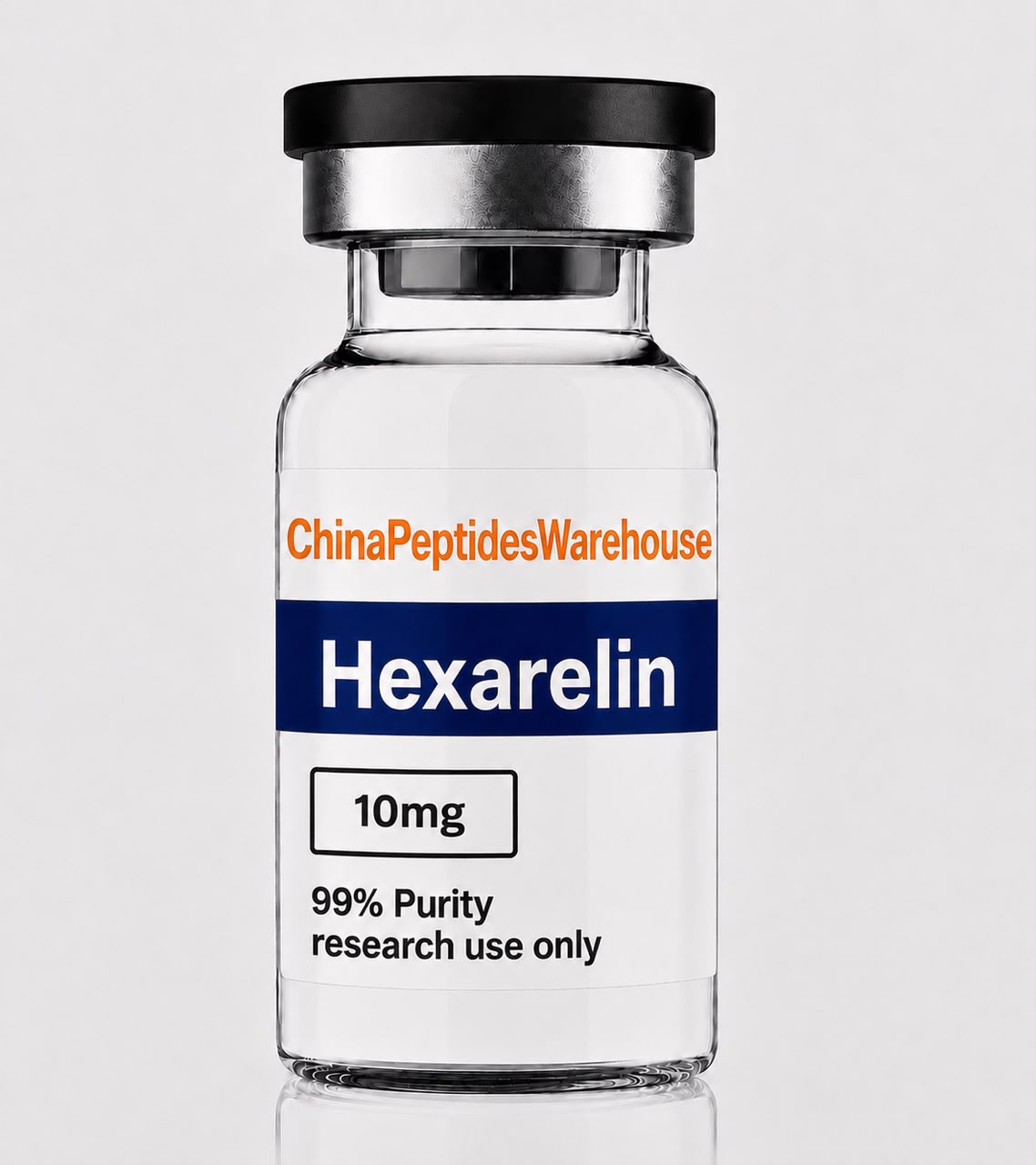
BUY HEXARELIN 10mg
$171.00
HEXARELIN (chemically classified as Examorelin; sequence: $\text{His-D-2-Me-Trp-Ala-Trp-D-Phe-Lys-NH}_2$) is a synthetic hexapeptide belonging to the Growth Hormone Releasing Peptide (GHRP) class. Derived from the molecular scaffold of GHRP-6,
incorporates non-natural amino acid substitutions—specifically D-2-methyl-tryptophan—that render the peptide substantially more resistant to proteolytic cleavage and degradation than native secretagogues.
HEXARELIN (Examorelin) Targeted Growth Hormone Secretagogue Guide
Advanced GHSR Agonism, CD36 Receptor-Mediated Cardioprotection, and Cellular Bioenergetic Regeneration
Product Overview & Core Attributes
HEXARELIN (chemically classified as Examorelin; sequence: $\text{His-D-2-Me-Trp-Ala-Trp-D-Phe-Lys-NH}_2$) is a synthetic hexapeptide belonging to the Growth Hormone Releasing Peptide (GHRP) class. Derived from the molecular scaffold of GHRP-6, HEXARELIN incorporates non-natural amino acid substitutions—specifically D-2-methyl-tryptophan—that render the peptide substantially more resistant to proteolytic cleavage and degradation than native secretagogues.
In endocrinological and cardiovascular research, HEXARELIN stands out as the most potent growth hormone secretagogue in the GHRP family. Operating via dual receptor-binding pathways, HEXARELIN functions as a high-affinity agonist at the Growth Hormone Secretagogue Receptor (GHSR-1a / ghrelin receptor) in the pituitary and hypothalamus. Simultaneously, it binds to the non-hormonal CD36 scavenger receptor expressed in cardiac and vascular tissues.
Through GHSR-1a activation, HEXARELIN triggers robust, dose-dependent, pulsatile amplification of endogenous Growth Hormone (GH), driving downstream Insulin-Like Growth Factor 1 (IGF-1) synthesis, accelerated lipolysis, enhanced nitrogen retention, and cellular repair. Concurrently, its CD36 receptor interaction mediates non-endocrine cardioprotective actions, reducing myocardial ischemic-reperfusion injury, stabilizing left ventricular function, and inhibiting apoptosis in cardiomyocytes independent of GH release.
                               +------------------------------------------+
                               |                 HEXARELIN                |
                               |    Synthetic Hexapeptide Dual Agonist    |
                               +--------------------+---------------------+
                                                    |
           +----------------------------------------+----------------------------------------+
           |                                                                                 |
           v                                                                                 v
+------------------------------------+                                            +------------------------------------+
|        GHSR-1a Receptor Binding     |                                            |        CD36 Scavenger Receptor      |
|    (Pituitary / Hypothalamus)      |                                            |    (Cardiac & Vascular Tissue)     |
+------------------+-----------------+                                            +------------------+-----------------+
                   |                                                                                 |
                   v                                                                                 v
  Amplifies Pulsatile Growth Hormone                                                Suppresses Ischemic Injury,
      & IGF-1 Signal Cascades                                                        Improves Left Ventricular Output
                   |                                                                                 |
                   v                                                                                 v
   Enhanced Lipolysis, Muscle Mass                                                  Direct Anti-Apoptotic Protection
    Development & Nitrogen Retention                                                 & Reduction in Cardiac Fibrosis
                   |                                                                                 |
                   +------------------------------------+--------------------------------------------+
                                                        |
                                                        v
                                       +----------------------------------+
                                       |  Systemic Tissue Regeneration,   |
                                       |   Metabolic Acceleration & Care  |
                                       +----------------------------------+
Key Technical Features:
-
Potent GH Secretagogue Agonism: Demonstrates the highest per-microgram binding affinity and GH elevation among synthetic GHRP peptides.
-
Dual-Action Receptor Targeting: Interacts with both the GHSR-1a receptor (endocrine release) and the CD36 receptor (cardiovascular tissue protection).
-
Proteolytic Enzyme Resistance: Non-natural amino acid substitutions (D-2-Me-Trp) extend structural stability against enzymatic degradation.
-
Targeted Lipolysis Support: Enhances free fatty acid oxidation and metabolic expenditure while supporting lean tissue accumulation.
-
Cardioprotective Properties: Promotes left ventricular ejection fraction improvement and inhibits apoptotic signaling in cardiomyocytes.
Technical & Chemical Specifications
Review the chemical, analytical, and physical properties defining research-grade HEXARELIN:
| Feature / Parameter | Analytical Specification |
| Chemical Name | Examorelin, L-histidyl-2-methyl-D-tryptophyl-L-alanyl-L-tryptophyl-D-phenylalanyl-L-lysinamide |
| CAS Registry Number | 140703-51-1 |
| Synonyms | EP-23905, MF-6003, H-2-Me-WAWFK |
| Molecular Formula | $\text{C}_{47}\text{H}_{58}\text{N}_{12}\text{O}_6$ |
| Molecular Weight | 887.04 g/mol |
| Peptide Sequence | His-D-2-Me-Trp-Ala-Trp-D-Phe-Lys-$\text{NH}_2$ |
| Purity Standard | $\ge 98.0\%$ (determined via RP-HPLC and ESI-MS) |
| Physical Appearance | Sterile, lyophilized white cake/powder |
| Solubility Profile | Fully soluble in sterile water, PBS ($\text{pH } 7.2$), DMSO, and DMF |
| Elimination Half-Life | Approximately 55–120 minutes post-subcutaneous administration |
| Storage Temperature | Freeze-stored at $-20^\circ\text{C}$ to $-80^\circ\text{C}$ in desiccated conditions |
Reconstitution & Handling Protocol
To ensure structural integrity and prevent enzymatic breakdown, standard aseptic protocols must be followed during reconstitution and laboratory handling.
+-------------------------------------------------------------------------+
|                  LABORATORY RECONSTITUTION STEPS                        |
+-------------------------------------------------------------------------+
| Step 1: Equilibrium   --> Allow vial to reach room temp (15-20 min)     |
| Step 2: Sterilization --> Clean rubber septum with 70% IPA swab         |
| Step 3: Diluent Intro --> Slow injection of Bacteriostatic Water        |
| Step 4: Solubilization--> Gentle circular swirling (DO NOT SHAKE)       |
| Step 5: Cold Storage  --> Store liquid at 2°C to 8°C (Refrigerated)     |
+-------------------------------------------------------------------------+
Reconstitution Standard:
-
Lyophilized Vial: Standard 2 mg or 5 mg sterile borosilicate glass vial.
-
Reagent Diluent: Bacteriostatic Water (0.9% Benzyl Alcohol preserved) or sterile physiological saline.
-
Equipment: Sterile 1 mL to 3 mL injection syringes with 21G–27G needles.
-
Disinfectant: Medical-grade 70% Isopropyl Alcohol (IPA) wipes.
Step-by-Step Reconstitution Protocol:
-
Temperature Stabilization: Allow the cold lyophilized vial to equilibrate to room temperature for 15 to 20 minutes before handling to prevent condensation inside the glass container.
-
Septum Preparation: Pop off the protective cap. Thoroughly wipe the rubber stopper using a fresh 70% IPA swab and permit it to air-dry completely.
-
Diluent Injection: Draw up the calculated diluent volume (e.g., 2.0 mL for a 2 mg vial yielding a 1 mg/mL concentration). Insert the needle through the septum center at a 45-degree angle.
-
Controlled Wall Flow: Depress the syringe plunger slowly, aiming the fluid stream against the inner glass wall. Avoid spraying liquid directly onto the lyophilized powder cake.
-
Solubilization: Allow the diluent to absorb into the powder. Gently swirl the vial in a smooth circular motion. Do not shake the vial violently, as shear forces can disrupt peptide amide bonds.
-
Visual Clarity Check: Confirm that the reconstituted liquid is completely clear, colorless, and free of undissolved particulate matter before use.
Storage Requirements & Temperature Stability
Adhering to proper environmental controls preserves peptide bioactivity and prevents thermal degradation over time:
+--------------------------------------------------------------------+
|                  TEMPERATURE STABILITY MATRIX                      |
+--------------------------------------------------------------------+
|  Dry Powder (-20°C to -80°C)  | Stable for up to 36 Months         |
|  Dry Powder (Room Temp / 20°C)| Stable for 2-4 Weeks (Transit)     |
|  Reconstituted Liquid (2°-8°C)| Stable for up to 6-8 Weeks         |
|  Reconstituted Liquid (>25°C) | Degrades Rapidly (Avoid Exposure)  |
+--------------------------------------------------------------------+
-
Unreconstituted Powder: Store lyophilized vials in a dark freezer at $-20^\circ\text{C}$ to $-80^\circ\text{C}$. Unhydrated samples remain chemically stable for up to 36 months under these conditions.
-
Reconstituted Solution: Once dissolved in bacteriostatic water, store the vial refrigerated at $2^\circ\text{C}$ to $8^\circ\text{C}$. Use within 60 days to maintain maximum potency.
-
Light Protection: Store vials inside secondary opaque packaging, away from direct UV radiation or bright light exposure.
Sourcing Standards & Procurement Guidance
When evaluating sources to HEXARELIN buy orders or selecting high-purity research materials online, reviewing independent analytical verification ensures reliable batch quality.
+--------------------------------------------------------------------+
|                 PEPTIDE SOURCING QUALITY CHECKLIST                 |
+--------------------------------------------------------------------+
|  [x] High-Performance Liquid Chromatography (HPLC) Purity >= 98%   |
|  [x] Mass Spectrometry (MS) Identity & Mass Verification (887.04)  |
|  [x] Trifluoroacetic Acid (TFA) Salt Exchange to Acetate Form      |
|  [x] Vacuum-Sealed Borosilicate Glass Vials with Desiccant         |
|  [!] AVOID: Sellers unable to supply lot-specific analytical COAs  |
+--------------------------------------------------------------------+
1. Analytical Certificate of Analysis (COA) Verification
Always require a lot-specific COA from an accredited independent testing facility. A valid analytical report must document:
-
RP-HPLC Analysis: Confirms total target peak area represents $\ge 98.0\%$ purity, ensuring freedom from synthesis truncation sequences.
-
Mass Spectrometry (ESI-MS): Validates the exact molecular weight matching the theoretical 887.04 Da standard.
-
Endotoxin & Residual Solvent Testing: Verifies endotoxin levels remain below $<0.5\text{ EU/mg}$ and confirms the removal of hazardous synthesis reagents.
2. Vendor Quality Evaluation
Laboratory researchers looking to buy HEXARELIN online should choose suppliers offering cold-chain delivery, batch traceability, and acetate salt formulations. Standard high-purity HEXARELIN for sale online is distributed in vacuum-sealed vials to preserve chemical stability during shipping. If you are comparing sources toHEXAREL IN buy stock for experimental use, confirm that third-party HPLC reports are accessible for every lot.
Customer & Researcher Reviews
Read documented feedback from laboratory researchers and clinical specialists evaluating peptide quality:
“Unmatched Secretagogue Potency in Endocrine Assays”
“Our comparative study evaluating secretagogue potency showed that this hexapeptide generated a higher initial GH peak than either GHRP-6 or GHRP-2 in cell culture models. Reconstitution was seamless, dissolving instantly in bacteriostatic water with complete clarity. HPLC testing from our lab confirmed 98.6% purity.”
— Dr. Aris M., Lead Metabolic Researcher
“Consistent Batch Quality for Cardioprotection Research”
“We utilize this peptide to analyze CD36 receptor interactions in cardiac cell models. Order delivery was prompt, arriving with complete lot-specific COA documentation. The sequence consistency across multiple batches has made our data collection predictable and reproducible.”
— Elena S., Senior Cardiovascular Biochemist
“Fast Delivery and Exceptional Solution Stability”
“Ordering research peptides online can present quality verification challenges, but this supplier provided verified mass spectrometry reports prior to purchase. The product maintained stability over our 6-week trial without loss of potency when kept at 4°C.”
— Marcus K., Laboratory Operations Director
Frequently Asked Questions (FAQ)
Q1: How does HEXARELIN differ from other GHRPs like GHRP-6 or GHRP-2?
While all GHRPs act on the GHSR-1a receptor, HEXARELIN incorporates structural modifications (D-2-Me-Trp) that make it more resistant to enzymatic degradation. It demonstrates higher per-microgram potency for GH release and uniquely binds the CD36 scavenger receptor to provide direct cardioprotection.
Q2: What is the significance of CD36 receptor binding?
The CD36 receptor is expressed in cardiovascular tissues. HEXARELIN binding at CD36 mediates non-hormonal, cytoprotective actions that help protect cardiac tissue against ischemic injury, improve left ventricular performance, and reduce myocardial fibrosis independently of growth hormone release.
Q3: What diluent should be used to reconstitute the peptide?
Sterile Bacteriostatic Water (0.9% Benzyl Alcohol preserved) is standard for multi-dose laboratory applications requiring refrigerated storage. For immediate single-use assays, sterile physiological saline (0.9% NaCl) or PBS may be used.
Q4: What is the average half-life of reconstituted solution?
Following subcutaneous administration, HEXARELIN exhibits a biological elimination half-life of approximately 55 to 120 minutes. Once reconstituted with bacteriostatic water and stored under refrigeration ($2^\circ\text{C}$ to $8^\circ\text{C}$), liquid vials remain chemically stable for up to 60 days.
Q5: Does receptor desensitization occur with continuous exposure?
Yes. In research settings, continuous or frequent administration of HEXARELIN can lead to downregulation (desensitization) of the GHSR-1a receptor response over time. Experimental protocols typically incorporate cycling periods to maintain receptor sensitivity.
Q6: How can researchers detect peptide degradation?
Physical signs of degradation include persistent turbidity, cloudiness, or insoluble precipitate after reconstitution. If the solution fails to clear completely after gentle circular swirling, discard the vial.
Q7: What analytical methods verify peptide quality?
Chemical purity is measured using Reverse-Phase High-Performance Liquid Chromatography (RP-HPLC). Exact molecular mass and sequence accuracy are verified via Electrospray Ionization Mass Spectrometry (ESI-MS).
Summary & Key Takeaways
HEXARELIN (Examorelin) remains a key compound in secretagogue research. By combining high-affinity GHSR-1a receptor agonism with non-hormonal CD36 scavenger receptor binding, this hexapeptide accelerates endogenous GH/IGF-1 release while offering direct cardioprotective benefits.
When selecting
for experimental research, choose suppliers that provide lot-specific COA documentation, verified HPLC purity testing, and proper cold-chain shipping to ensure reliable experimental outcomes.
Reviews
There are no reviews yet.