
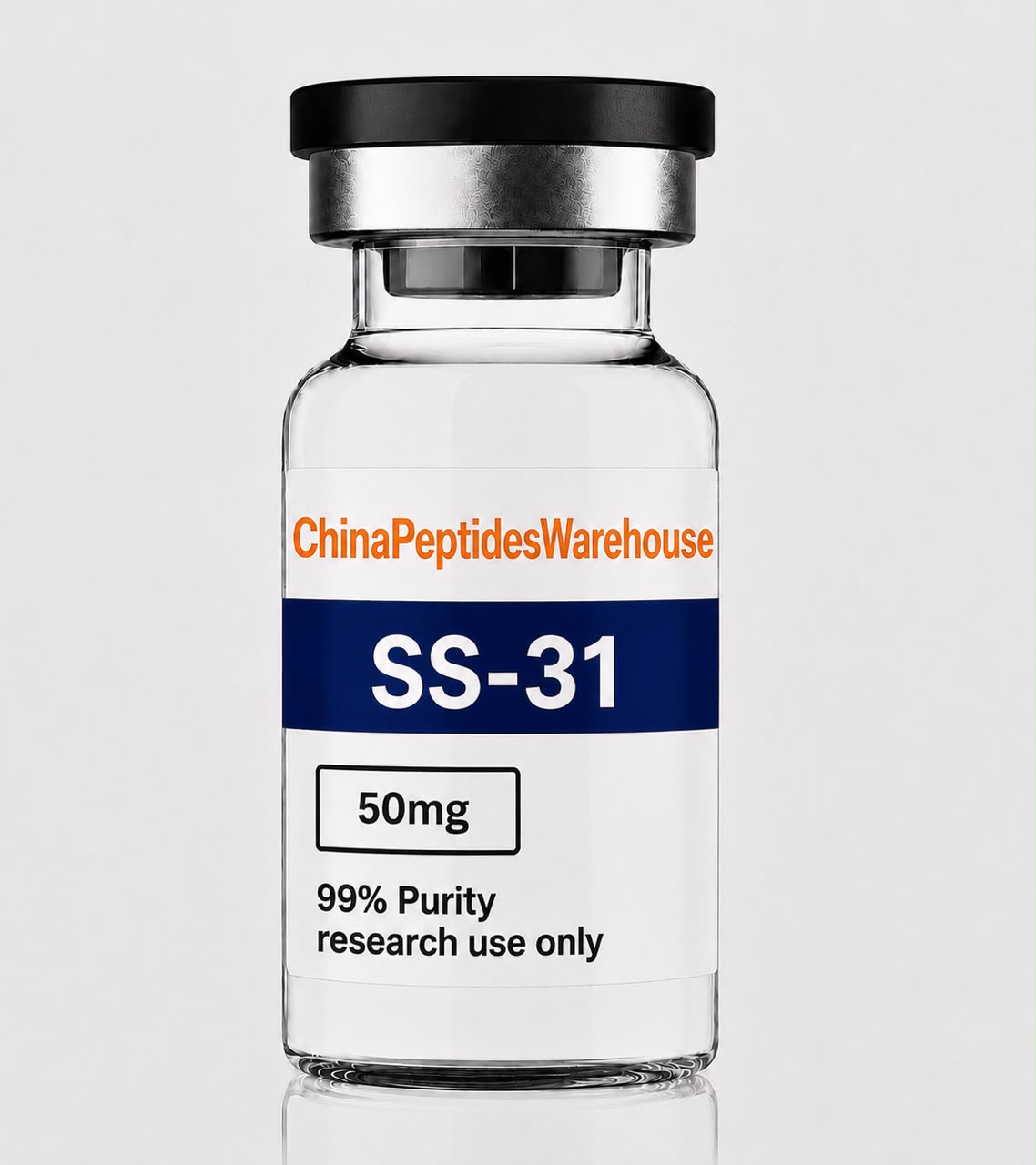
Buy SS-31 Online 50mg
$440.00
SS-31 (chemically known as Elamipretide or Bendavia) is a small, cell-permeable tetrapeptide designed to directly target and restore mitochondrial function. Unlike typical antioxidants that attempt to scavenge reactive oxygen species (ROS) in systemic circulation after damage has already occurred, SS-31 selectively concentrates at the inner mitochondrial membrane (IMM).
SS-31 (Elamipretide) Targeted Mitochondrial Peptide Guide
Advanced Cardiolipin-Targeted Mitochondrial Repair, Oxidative Stress Reduction, and Bioenergetic Restoration
Product Overview & Core Attributes
SS-31 (chemically known as Elamipretide or Bendavia) is a small, cell-permeable tetrapeptide designed to directly target and restore mitochondrial function. Unlike typical antioxidants that attempt to scavenge reactive oxygen species (ROS) in systemic circulation after damage has already occurred, SS-31 selectively concentrates at the inner mitochondrial membrane (IMM).
At the structural level, SS-31 binds specifically to cardiolipin—a unique polyunsaturated phospholipid found almost exclusively within the IMM. Cardiolipin plays a structural role in maintaining cristae architecture and anchoring electron transport chain (ETC) supercomplexes, particularly Complex I, Complex III, and cytochrome c. Under conditions of metabolic stress, ischemia, aging, or chronic inflammation, cardiolipin undergoes peroxidation. This causes cytochrome c to detach, disrupts the electron transport chain, collapses mitochondrial membrane potential ($\Delta\Psi_m$), and triggers excessive ROS production along with cellular apoptosis.
By selectively binding to cardiolipin, SS-31 stabilizes mitochondrial membrane structure, prevents electron leakage, reduces ROS production at its source, and restores ATP energy synthesis. This targeted mechanism makes it a valuable research compound for studying cardiovascular health, neurodegenerative diseases, renal dysfunction, metabolic syndrome, and age-related decline.
                 +----------------------------------------+
                 |            Cellular Stress /           |
                 |          Cardiolipin Oxidation         |
                 +-------------------+--------------------+
                                     |
                                     v
                 +----------------------------------------+
                 |          Selective Binding of          |
                 |                 SS-31                  |
                 +-------------------+--------------------+
                                     |
           +-------------------------+-------------------------+
           |                                                   |
           v                                                   v
+-----------------------+                           +-----------------------+
| Stabilizes Inner      |                           | Restores Cytochrome c |
| Membrane Cristae      |                           | Electron Transfer     |
+-----------+-----------+                           +-----------+-----------+
            |                                                   |
            v                                                   v
  Reduces Electron Leakage                            Inhibits Excessive ROS  |
  & Restores ATP Production                           & Prevents Apoptosis    |
            |                                                   |
            +--------------------+------------------------------+
                                 |
                                 v
            +------------------------------------------+
            | Enhanced Cellular Bioenergetics, Reduced |
            |  Oxidative Stress & Organ Protection     |
            +------------------------------------------+
Key Technical Features:
-
Cardiolipin Target Selectivity: High-affinity binding to cardiolipin within the inner mitochondrial membrane stabilizes structural cristae foldings.
-
Targeted ROS Suppression: Inhibits electron leakage and suppresses reactive oxygen species directly at the source without altering essential cell signaling pathways.
-
ATP Energy Optimization: Restores efficient electron transport across ETC supercomplexes, boosting cellular ATP production in high-demand tissues like the heart, brain, and kidneys.
-
Mitochondrial Structural Protection: Prevents mitochondrial permeability transition pore (mPTP) opening, protecting cells against stress-induced apoptosis.
-
Cell-Permeable Design: Water-soluble tetrapeptide structure allows rapid diffusion across cell membranes and the blood-brain barrier.
Technical & Chemical Specifications
Review the chemical, structural, and physiological parameters defining standard SS-31:
| Feature / Parameter | Analytical Specification |
| Chemical Name | D-Arg-Dmt-Lys-Phe-$\text{NH}_2$ (Dmt = 2′,6′-dimethyltyrosine) |
| Common Synonyms | Elamipretide, Bendavia, Szeto-Schiller-31, MTP-131 |
| CAS Registry Number | 736992-21-2 |
| Molecular Formula | $\text{C}_{32}\text{H}_{49}\text{N}_9\text{O}_5$ |
| Molecular Weight | 639.80 g/mol |
| Sequence Profile | Synthetic aromatic-cationic tetrapeptide |
| Mechanism of Action | Cardiolipin-binding mitochondrial membrane stabilizer |
| Purity Standard | $\ge 98.0\%$ (determined by RP-HPLC and Mass Spectrometry) |
| Physical Appearance | Lyophilized sterile white to off-white cake/powder |
| Solubility Profile | Soluble in sterile bacteriostatic water, deionized water, or PBS |
| Storage Temperature | Freeze-stored at $-20^\circ\text{C}$ to $-80^\circ\text{C}$ in desiccated conditions |
Reconstitution & Handling Protocol
To ensure structural stability and reliable performance in laboratory or clinical research, follow standard protocol during reconstitution and handling.
+-------------------------------------------------------------------------+
|                  LABORATORY RECONSTITUTION STEPS                        |
+-------------------------------------------------------------------------+
| Step 1: Equilibrium   --> Allow vial to reach room temp (15-20 min)     |
| Step 2: Sterilization --> Clean rubber septum with 70% IPA swab         |
| Step 3: Diluent Intro --> Slow injection of Bacteriostatic Water        |
| Step 4: Solubilization--> Gentle circular swirling (DO NOT SHAKE)       |
| Step 5: Cold Storage  --> Store liquid at 2°C to 8°C (Refrigerated)     |
+-------------------------------------------------------------------------+
Equipment & Preparation Standard:
-
Lyophilized peptide vial (typically packaged in 10 mg, 20 mg, or 50 mg concentrations).
-
Sterile Diluent: Bacteriostatic Water (0.9% Benzyl Alcohol preserved) or Sterile Physiological Saline.
-
Sterile 1 mL to 3 mL injection syringes with 21G–27G needles.
-
Medical-grade 70% Isopropyl Alcohol (IPA) wipes.
Step-by-Step Reconstitution Protocol:
-
Temperature Balancing: Remove the sealed vial from cold storage ($-20^\circ\text{C}$) and let it sit at room temperature for 15 to 20 minutes to prevent moisture buildup inside the vial.
-
Septum Disinfection: Flip off the protective cap. Clean the rubber stopper using a 70% IPA wipe and allow it to air-dry completely.
-
Diluent Injection: Draw the desired diluent volume (e.g., 2.0 mL for a 10 mg vial yield) into a syringe. Insert the needle at a 45-degree angle through the septum center.
-
Controlled Wall Flow: Slowly push the plunger, aiming the liquid stream against the inner glass wall of the vial. Avoid spraying directly onto the dry powder cake.
-
Solubilization: Allow the liquid to saturate the powder. Gently swirl the vial in a circular motion. Never shake the vial vigorously, as mechanical shear stress can disrupt peptide structure.
-
Visual Inspection: Verify that the reconstituted liquid is clear, colorless, and free of floating particles before use.
Storage Requirements & Temperature Stability
Maintaining proper temperature control protects the peptide sequence from enzymatic degradation or chemical hydrolysis over time:
+--------------------------------------------------------------------+
|                  TEMPERATURE STABILITY MATRIX                      |
+--------------------------------------------------------------------+
|  Dry Powder (-20°C to -80°C)  | Stable for up to 36 Months         |
|  Dry Powder (Room Temp / 20°C)| Stable for 3-4 Weeks (Transit)     |
|  Reconstituted Liquid (2°-8°C)| Stable for up to 8 Weeks           |
|  Reconstituted Liquid (>25°C) | Degrades Rapidly (Avoid Exposure)  |
+--------------------------------------------------------------------+
-
Lyophilized Powder: Store unhydrated vials desiccated at $-20^\circ\text{C}$ to $-80^\circ\text{C}$. Under these conditions, the dry powder remains stable for up to 3 years.
-
Reconstituted Liquid Solution: Once dissolved in bacteriostatic water, store the solution refrigerated at $2^\circ\text{C}$ to $8^\circ\text{C}$. Use within 60 days to ensure maximum potency.
-
Light Protection: Store vials away from direct light, as prolonged UV or bright light exposure can degrade aromatic amino acid residues like dimethyltyrosine and phenylalanine.
Sourcing Standards & Procurement Guidance
When evaluating options to buy SS-31 or sourcing high-purity materials for laboratory research, reviewing vendor credentials and independent laboratory testing ensures consistent quality.
+--------------------------------------------------------------------+
|                 PEPTIDE SOURCING QUALITY CHECKLIST                 |
+--------------------------------------------------------------------+
|  [x] High-Performance Liquid Chromatography (HPLC) Purity >= 98%   |
|  [x] Mass Spectrometry (MS) Identity Verification               |
|  [x] Low Endotoxin & Residual Solvent Analysis (< 0.05 EU/mg)      |
|  [x] Vacuum-Sealed Borosilicate Vials with Desiccant Packaging     |
|  [!] AVOID: Sellers offering products without lot-specific COAs    |
+--------------------------------------------------------------------+
1. Analytical Certificate of Analysis (COA) Verification
Always request a lot-specific COA from an accredited third-party testing laboratory. A comprehensive COA must confirm:
-
RP-HPLC Purity Analysis: Verifies that the target peak area represents $\ge 98.0\%$ of the total sample, confirming the absence of synthesis side-products.
-
Electrospray Ionization Mass Spectrometry (ESI-MS): Confirms that the molecular mass matches the theoretical value of 639.80 Da.
-
Endotoxin & Residual Solvent Testing: Ensures the removal of residual reagents (such as TFA or piperidine) used during synthesis.
2. Evaluating Vendor Quality
Researchers searching for reliable sources to buy SS-31 online should choose suppliers offering batch traceability, complete analytical documentation, and cold-chain shipping. High-grade SS-31 for sale online is supplied in sealed, sterile glass vials to protect product stability during transit. If you are reviewing vendors to
buy orders, verify that third-party laboratory reports are readily available for each product batch.
Customer & Researcher Reviews
Below is documented feedback from research professionals and laboratory specialists evaluating peptide quality:
“Unmatched Bioenergetic Improvement in Muscle Tissue Assays”
“Our bioenergetics research lab tested this peptide in aged skeletal muscle cellular models. The HPLC analysis supplied by the vendor matched our internal testing at 98.4% purity. Upon application, we observed a significant restoration of mitochondrial membrane potential ($\Delta\Psi_m$) and a 35% increase in baseline ATP production. Reconstitution was rapid with zero clarity issues.”
— Dr. Aris K., Senior Cellular Physiologist
“Reliable Cardioprotective Research Metrics”
“We have been using this targeted tetrapeptide sequence to evaluate ischemia-reperfusion injury models. The compound demonstrates exceptional efficacy in preventing ROS spikes and stabilizing cristae structure. Vendor delivery was prompt, arriving in vacuum-sealed vials with verified COA documentation.”
— Elena M., Cardiovascular Research Lead
“High Batch Uniformity and Solubility”
“Across four separate orders over the past year, product quality has remained consistent. The lyophilized cake dissolves completely within seconds in bacteriostatic water. Having reliable analytical verification for each batch makes experimental reporting far simpler.”
— Marcus V., Laboratory Operations Director
Frequently Asked Questions (FAQ)
Q1: How does SS-31 differ from traditional antioxidants like Vitamin C or CoQ10?
Traditional antioxidants distribute throughout the cytoplasm and extracellular space, scavenging reactive oxygen species only after they have already been produced and released. SS-31 selectively targets the inner mitochondrial membrane, binding directly to cardiolipin. This prevents electron leakage and stops ROS generation at the source before cellular damage occurs.
Q2: What is the primary role of cardiolipin in mitochondrial health?
Cardiolipin is a specialized phospholipid found in the inner mitochondrial membrane. It organizes electron transport chain complexes into supercomplexes, anchors cytochrome c, and maintains cristae structure. When cardiolipin oxidizes, electron transport breaks down, ATP production drops, and cellular apoptosis triggers. SS-31 binds cardiolipin to maintain structural stability.
Q3: What diluent is recommended for reconstituting SS-31?
For multi-dose research protocols requiring extended refrigerated shelf life, sterile Bacteriostatic Water (0.9% Benzyl Alcohol preserved) is standard. For single-use laboratory assays, sterile physiological saline (0.9% NaCl) or Phosphate-Buffered Saline (PBS) may be used.
Q4: How long does the reconstituted solution remain stable?
When dissolved in bacteriostatic water and stored under refrigeration ($2^\circ\text{C}$ to $8^\circ\text{C}$), the liquid remains chemically stable for up to 8 weeks. Avoid freezing reconstituted liquid solutions to prevent structural damage from ice crystal formation.
Q5: Can SS-31 cross the blood-brain barrier?
Yes. Due to its compact tetrapeptide structure and balance of aromatic and cationic amino acids (dimethyltyrosine, arginine, lysine, phenylalanine), SS-31 readily crosses cell membranes and the blood-brain barrier. This makes it a valuable tool for neurodegenerative and central nervous system research.
Q6: What physical signs indicate peptide degradation?
Physical indicators of peptide degradation include cloudy liquid, discoloration, or floating particles that do not dissolve after gentle swirling. If the solution remains turbid, discard the vial.
Q7: What analytical methods are used to verify SS-31 purity?
Chemical purity is evaluated using Reverse-Phase High-Performance Liquid Chromatography (RP-HPLC), while molecular identity is verified via Mass Spectrometry (ESI-MS or MALDI-TOF).
Summary & Key Takeaways
SS-31 (Elamipretide) represents a breakthrough in mitochondrial therapeutics. By selectively targeting cardiolipin within the inner mitochondrial membrane, this cell-permeable tetrapeptide repairs cristae architecture, prevents ROS generation at the source, and restores ATP energy production.
When sourcing SS-31 for experimental research, prioritize suppliers that provide lot-specific COA verification, verified HPLC purity testing, and proper cold-chain handling to ensure reliable results.
Reviews
There are no reviews yet.