
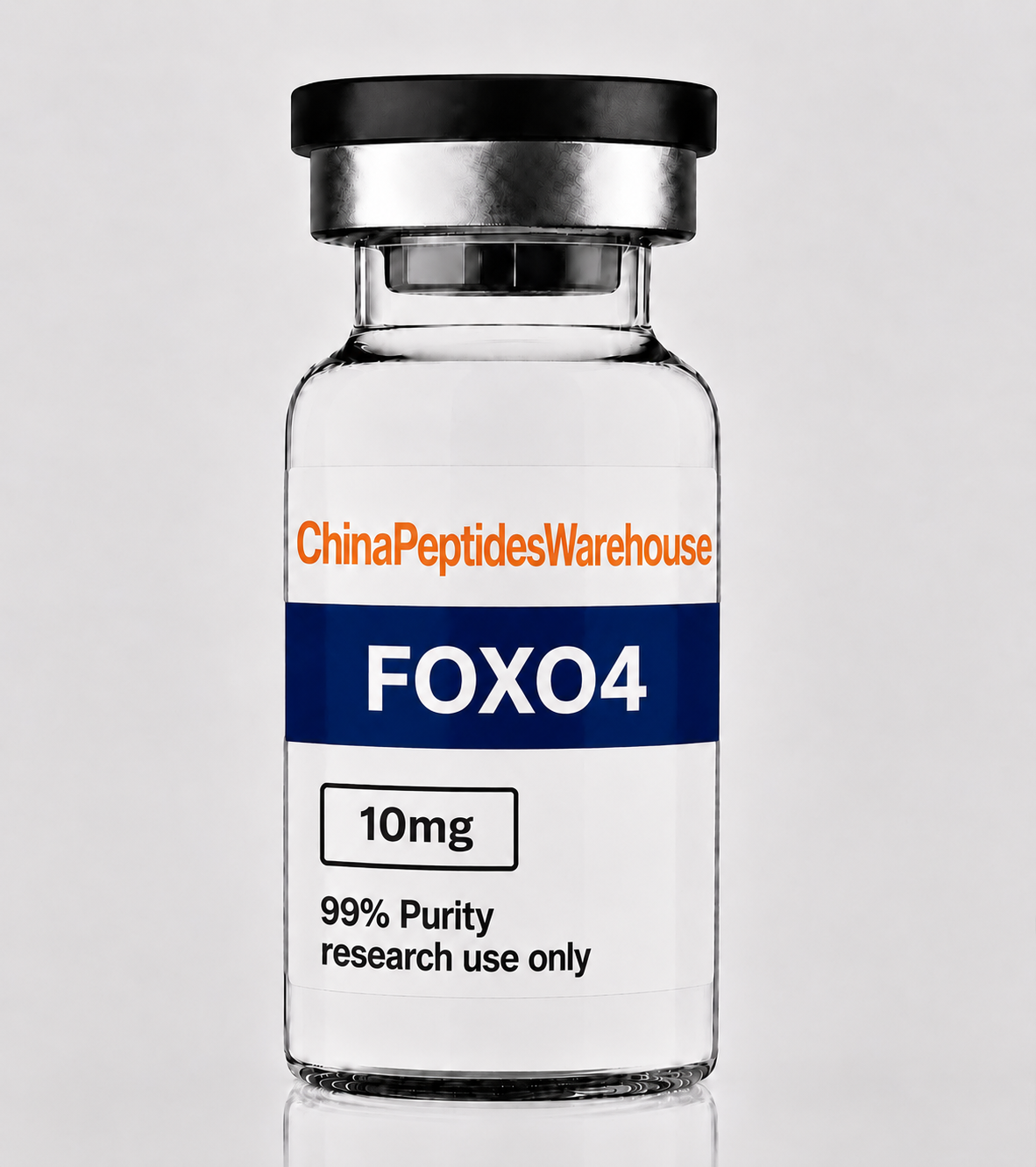
BUY FOXO4 10mg-ONLINE
Original price was: $360.00.$350.00Current price is: $350.00.
FOXO4 is a peptide associated with research into cellular aging, senescence, and molecular pathways involved in cell survival. As interest in longevity science and cellular biology continues to grow, FOXO4 has attracted attention within research communities investigating how cells respond to stress, aging-related changes, and signaling mechanisms
FOXO4: Research Overview, Product Information & Key Considerations
FOXO4 is a peptide associated with research into cellular aging, senescence, and molecular pathways involved in cell survival. As interest in longevity science and cellular biology continues to grow, FOXO4 has attracted attention within research communities investigating how cells respond to stress, aging-related changes, and signaling mechanisms.
This page provides an educational overview of FOXO4, including its research background, scientific relevance, quality considerations, and frequently asked questions. It is intended for research and educational purposes rather than as a recommendation for human treatment or self-administration.
What Is FOXO4?
FOXO4 refers to Forkhead Box O4, a member of the FOXO family of transcription factors. FOXO proteins are involved in regulating several important cellular processes, including stress responses, metabolism, cell-cycle regulation, and mechanisms associated with cellular longevity.
FOXO4 has become particularly interesting in research examining cellular senescence. Senescent cells are cells that have stopped dividing but can remain metabolically active and release signaling molecules that influence surrounding tissues. Researchers are studying how these cells develop, persist, and interact with their cellular environment.
Interest in FOXO4 has also increased because of experimental research involving interactions between FOXO4-related pathways and proteins involved in cellular survival. These investigations form part of a broader effort to understand the biological mechanisms underlying aging and age-associated cellular changes.
FOXO4 Research Applications
Research involving FOXO4 spans several areas of molecular and cellular biology. Researchers may investigate FOXO-related signaling to better understand:
- Cellular stress responses
- Transcription-factor activity
- Cellular senescence
- Apoptosis and cell survival pathways
- Aging-related molecular mechanisms
- Oxidative stress
- Cell-cycle regulation
- Metabolic signaling
- Longevity-associated biological pathways
These research areas are still developing. Findings from laboratory and preclinical studies should not automatically be interpreted as evidence that a peptide produces the same effects in humans.
Why Is FOXO4 Studied in Aging Research?
One reason FOXO4 receives attention is its relationship with pathways involved in cellular stress and survival. FOXO proteins can influence the expression of genes involved in maintaining cellular homeostasis.
Cellular aging is a complex biological process involving numerous pathways rather than a single molecular target. Researchers therefore examine FOXO4 alongside other mechanisms to understand how cells respond to DNA damage, oxidative stress, metabolic changes, and other forms of cellular stress.
Experimental work involving FOXO4-derived peptides has contributed to interest in whether certain molecular interactions could influence the behavior of senescent cells. However, these findings remain part of an evolving research field and should not be presented as established clinical outcomes.
FOXO4 and Cellular Senescence Research
Cellular senescence is one of the most widely discussed areas connected with FOXO4 research.
Senescent cells can accumulate under certain biological conditions. Although senescence can serve useful functions in normal biology, researchers are investigating how the long-term accumulation and signaling activity of senescent cells may relate to aging and disease processes.
FOXO4 has been investigated because of its involvement in cellular signaling associated with senescence and survival. Research into FOXO4-derived molecules has therefore become part of the wider field of senolytic research.
It is important to distinguish experimental research findings from established medical applications. Research involving laboratory models does not establish that a FOXO4-related product is safe or effective for treating aging, disease, or any particular medical condition.
Product Quality and Research Standards
For laboratories evaluating FOXO4, product quality and documentation are important considerations.
A research-grade peptide should be accompanied by appropriate documentation that allows researchers to evaluate its identity and quality. Depending on the supplier and intended laboratory application, useful documentation may include:
- Certificate of Analysis (CoA)
- Peptide identification information
- Purity testing
- Analytical testing data
- Batch or lot information
- Storage recommendations
- Manufacturing information
- Packaging and labeling details
Purity alone does not establish biological activity, safety, or suitability for a particular experiment. Researchers should evaluate products according to their own institutional protocols and applicable laboratory standards.
FOXO4 Peptide Research Considerations
When researching FOXO4, investigators should consider experimental design, peptide characterization, storage conditions, analytical verification, and appropriate controls.
Peptide research can be sensitive to factors such as purity, formulation, handling, storage, and experimental conditions. Consequently, researchers should rely on validated laboratory procedures and appropriate controls rather than assuming that results from one experimental setup will necessarily apply to another.
Researchers should also distinguish between the name of a peptide, a specific peptide sequence, and a particular formulation. These distinctions can be important when comparing research products or interpreting scientific literature.
FOXO4 vs. General Longevity Research
The growing interest in FOXO4 is part of a much larger scientific field examining the biology of aging.
Longevity research includes areas such as:
- Cellular senescence
- Autophagy
- Mitochondrial function
- DNA repair
- Epigenetic regulation
- Metabolic signaling
- Oxidative stress
- Stem-cell biology
- Inflammation
- Proteostasis
FOXO4 is therefore best understood as one research target within a complicated biological network rather than as a standalone explanation for aging.
Choosing Research Materials
When evaluating a FOXO4 research product, researchers should look beyond marketing terminology. Transparent product information can make it easier to determine whether a material is appropriate for a particular laboratory investigation.
Important questions include:
- Is the material clearly identified?
- Is analytical documentation available?
- Is the stated purity supported by testing?
- Is the batch or lot clearly documented?
- Are storage requirements provided?
- Is the product clearly labeled for research purposes?
- Does the supplier provide appropriate technical information?
These considerations can help laboratories maintain consistent research practices and improve reproducibility.
FOXO4 for Research and Educational Use
Interest in FOXO4 continues to grow as researchers investigate the molecular biology of aging and cellular senescence. Its relationship with FOXO signaling makes it a subject of interest for experimental studies involving cellular stress, survival mechanisms, and senescence-associated pathways.
However, scientific interest should not be confused with clinical validation. Research findings can change as additional studies are conducted, and laboratory observations may not translate directly into outcomes in humans.
For that reason, FOXO4 should be approached as a research subject requiring appropriate scientific oversight rather than as an established anti-aging treatment.
Frequently Asked Questions About FOXO4
What is FOXO4?
FOXO4 is a member of the Forkhead Box O family of transcription factors. It participates in cellular signaling and has been studied in connection with stress responses, cell survival, metabolism, and cellular senescence.
Why is FOXO4 studied in aging research?
Researchers study FOXO4 because of its involvement in molecular pathways associated with cellular stress, survival, and senescence. These pathways are relevant to broader investigations into the biology of aging.
Is FOXO4 an approved treatment for aging?
Research interest in FOXO4 does not mean that FOXO4-based products are established or approved treatments for aging. Regulatory status depends on the specific product and jurisdiction.
Is FOXO4 intended for human use?
Research-grade FOXO4 products should not be assu
Reviews
There are no reviews yet.